Best First Photo for a Dating Profile: What Men Should Lead With
Your first photo is not required to explain your whole life. It needs to win permission for the rest of the profile. Men often choose a dramatic mountain image, formal wedding portrait or gym mirror because it feels impressive. The better lead image is usually less complicated: clear face, current appearance, calm confidence.
Key takeaways
- Lead with one person: you.
- Show the eyes and current face clearly.
- Use flattering light without deceptive editing.
- Choose approachability over a hard performance.
- Test the photo with relevant strangers, not only close friends.
In this guide
- The five tests a lead photo must pass
- Use light that shapes the face without looking staged
- Frame for a phone, not a desktop portfolio
- Expression: warm confidence beats forced intensity
- Get better selection data
- What should not be first
- Lead-photo decision table
- Action checklist
- Frequently asked questions
The five tests a lead photo must pass
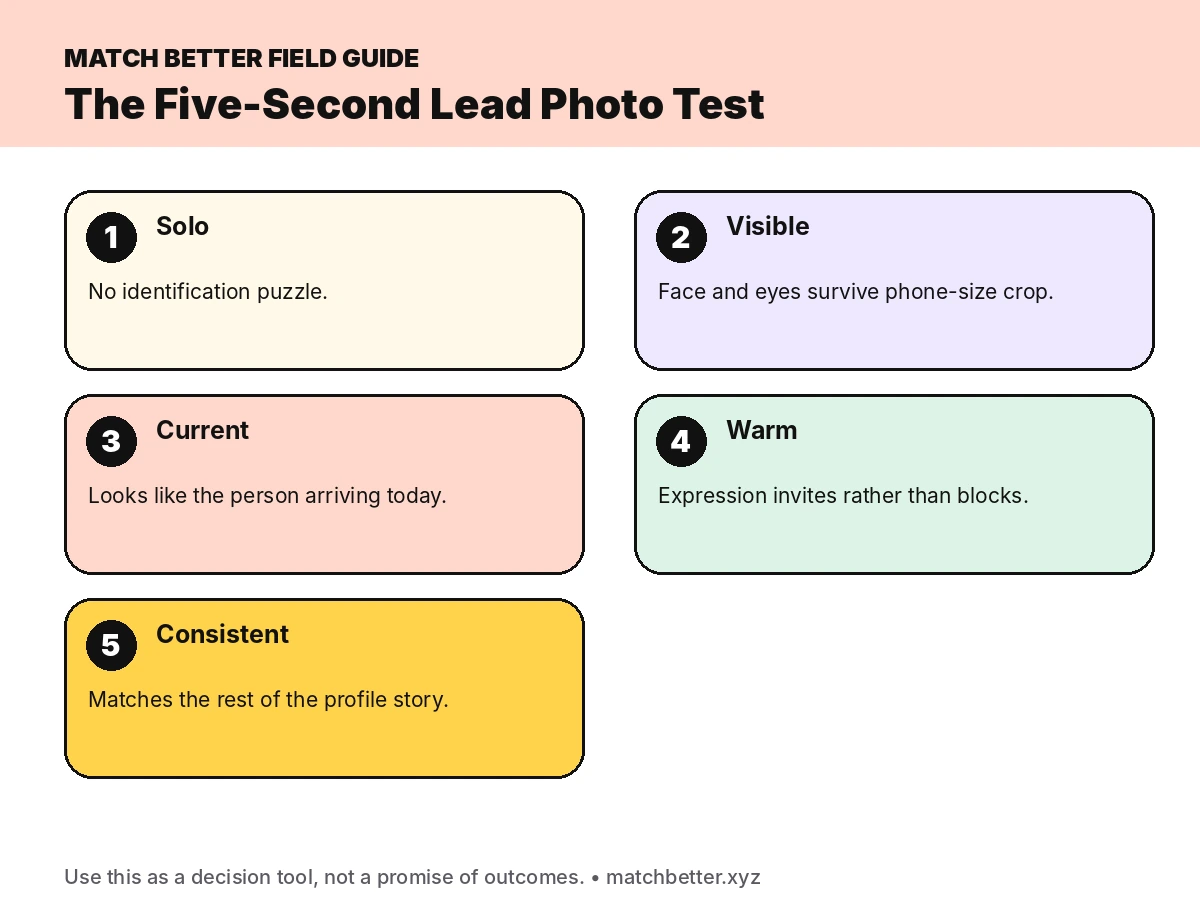
A strong first image passes five tests in under two seconds.
- Identity: there is no doubt which person is you.
- Visibility: the face is large enough on a small screen.
- Accuracy: hair, beard, build and age feel current.
- Approachability: the expression does not create unnecessary distance.
- Continuity: the image belongs with the rest of the profile.
Failing one test can be enough. A professionally shot group image still fails identity. A striking 2019 portrait may fail accuracy. A clear passport-style photograph can fail approachability. The best lead photo is not merely attractive in isolation; it is efficient at removing uncertainty.
Use light that shapes the face without looking staged
Stand in open shade outdoors, near a large window or just inside a doorway. Direct midday sun creates hard shadows and squinting. A ceiling light alone often produces dark eye sockets. Soft light from slightly above and in front of you is forgiving and believable.
Keep the background several feet behind you so the camera separates you from it. A quiet street, textured wall, café exterior, balcony with clean lines or green space works. Avoid visual clutter directly behind the head.
Do not flatten every skin texture with beauty filters. Bumble’s current guidance explicitly recommends avoiding heavy filters and overly edited pictures. Basic exposure, crop and colour correction are fine; changing facial structure is not.
Frame for a phone, not a desktop portfolio
Use the phone’s main camera rather than the ultra-wide front camera when possible. Position it at eye or upper-chest height and step back. Crop from roughly chest or waist upward with a little space above the head.
Your face should remain obvious when the image is reduced to a profile card. Test this by viewing the app preview at normal brightness, not by zooming into the original photograph.
Do not place your face at the very edge. Apps crop differently across feed cards, full profiles and social previews. A centred or gently off-centre composition survives those variations better than an experimental crop.
Expression: warm confidence beats forced intensity
A full toothy smile is not mandatory. Neutral can work when the eyes and posture remain engaged. The problem is not seriousness; it is emotional ambiguity. Tight jaw, lowered chin, folded arms and a dark background can stack into a “do not approach” signal even when none was intended.
Try three versions in the same light: a natural smile, a small closed-mouth smile and a relaxed neutral expression. Keep shoulders down, extend the neck gently and breathe out before the shutter.
Choose the version that feels most like you in a good first conversation. A lead photograph is a promise about the energy of meeting you.
Get better selection data
Close friends may prefer an image because they remember the event. You need feedback from people who do not have that context. Show three candidates for five seconds each and ask: “Which person would you most comfortably start a conversation with?” Then ask which looks most accurate and current.
Research on profile-photo selection suggests people can make weaker choices for themselves than outside viewers do. That does not mean outsourcing your identity. It means using external first impressions to challenge attachment.
If Bumble’s Best Photo or Hinge’s Top Photo is available, let it provide another performance signal. Remove any image that performs while misrepresenting you; keep long-term trust above short-term clicks.
What should not be first
Do not lead with a group, sunglasses, helmet, distant travel scene, gym mirror, car interior, cropped ex-partner, old graduation image or photo where a pet covers half the face. Any one of those might appear later when it adds useful context.
Also avoid opening with a highly formal Indian wedding photograph unless that look closely matches your everyday appearance and the crop remains warm. It can be a strong polished slot later, but it often tells too little about daily life.
The lead image should make the next five photographs easier to understand, not force the viewer to investigate.
Lead-photo decision table
| Candidate | Keep as first? | Reason |
|---|---|---|
| Bright solo waist-up portrait, current haircut, small smile | Yes | Clear, current and approachable |
| Formal wedding portrait with heavy event lighting | Maybe later | Polished but may feel distant or occasion-specific |
| Trekking image with you occupying 15% of the frame | No | Good story photo, poor recognition |
| Car selfie in sunglasses | No | Hidden eyes, repetitive angle and little context |
| Candid laugh at dinner, clean crop, no other faces | Strong option | Warm and believable if sharp enough |
| Studio headshot with aggressive retouching | No | Clear but low on accuracy and trust |
Action checklist
- Select three recent solo candidates.
- Check each at normal app-card size.
- Reject hidden eyes, distant crops and old appearances.
- Use open shade or window light.
- Compare smile, soft smile and relaxed neutral versions.
- Ask relevant strangers about approachability and accuracy.
- Test app photo-order tools where available.
- Keep accuracy above short-term performance.
Frequently asked questions
Should men smile in the first dating profile photo?
A natural smile often helps approachability, but it is not mandatory. A relaxed neutral expression can work when the eyes, posture and light remain open. Avoid stacking several hard signals into an unintentionally intimidating image.
Can the first photo be full body?
It can, but only when the face remains clear at phone size. For most profiles, a chest-up or waist-up lead handles recognition better, followed by a full-body image in slot two or three.
Should I look directly at the camera?
Direct eye contact is usually effective for a lead photo. A slight off-camera candid can also work when the face is clear and the expression feels engaged.
Is a professional headshot good for Bumble or Hinge?
It can be one candidate, but avoid a corporate LinkedIn feel or strong retouching. The image should look social and current rather than like a job application.
How do I know whether a first photo is working?
Track directional match quality after a controlled change, use available Best Photo or Top Photo tools, and compare external ratings. Do not draw conclusions from one evening.
Sources and update notes
This guide was checked against official product documentation and primary research available on 9 September 2026. Dating-app features can change by market, account and app version.
- Bumble Support: Uploading profile photos and videos
- Bumble Support: Standing out on Bumble
- Hinge: Profile refresh guide
- Cognitive Research: Principles and Implications — people often choose weaker profile images of themselves
- Frontiers in Psychology — self-taken versus other-taken profile photos and first impressions
Read next
Find your actual bottleneck
More swipes will not rewrite a weak profile. Take Match Better's free, private diagnosis and get a clear first fix: Start the free diagnosis.
Match Better is an independent education and coaching product for adults 18+. Bumble and Hinge are trademarks of their respective owners. No outcome is guaranteed. Never share a dating-app password with a coach or tool.