Bumble vs Hinge for Indian Men: Which Dating App Should You Use?
“Which app is better?” sounds like a product question but usually hides a profile question. A man with six good photos and specific prompts may perform differently from the same man using wedding pictures and copied jokes. Local pool size also changes by city, age and intention. The useful comparison is how each product asks you to present yourself, discover people and begin conversation—and which workflow makes you behave better.
Key takeaways
- Hinge is built around individual photos and prompts that can receive Likes and comments.
- Bumble offers a fuller card-style profile and now gives both people an opening-message opportunity in heterosexual matches.
- Each app has different recommendation, priority and paid-distribution tools.
- Do not compare one polished profile with one neglected profile.
- Run a measured free test before deciding or subscribing.
In this guide
- The practical comparison at a glance
- Choose Hinge when profile detail helps you
- Choose Bumble when the broader card works for you
- Which app is better for a serious relationship?
- Which app is easier for men to get matches on?
- Run a fair four-week test
- The two-app strategy without burnout
- Which app fits which working style?
- Action checklist
- Frequently asked questions
The practical comparison at a glance
| Dimension | Bumble | Hinge |
|---|---|---|
| Profile interaction | Swipe on a full profile; Notes can be sent before matching | Like or comment on a specific photo or prompt |
| Conversation start | Current 72-hour opening window; either person can send one opening message in heterosexual matches | A Like/comment becomes a match when accepted, then either person can message |
| Discovery surfaces | Main deck plus Discover suggestions | Discover, Most Compatible and Standouts |
| Profile emphasis | Photos, bio, prompts, interests and badges | Required mix of photos/videos and prompt-led personality |
| Priority tools | Spotlight, SuperSwipe/Notes and subscription features | Roses, Boost/Superboost, Hinge+ and HingeX |
| Useful for | People who like broader profile scanning and Bumble’s workflow | People who can write strong comments and specific prompts |
This table compares product mechanics, not user-base quality. Availability and exact features can vary.
Choose Hinge when profile detail helps you
Hinge makes each photo or prompt an interaction surface. A person can Like a specific element and attach a comment. That structure rewards profiles with clear hooks: an activity that invites a question, an opinion that creates a light debate or a prompt that reveals a value.
Hinge also offers specialised discovery. Discover focuses on mutual preference fit; Most Compatible highlights a predicted connection; Standouts presents high-attention profiles where Roses are used; Signals can display recent thoughtful-participation patterns.
Hinge may suit you when writing specific comments feels natural, you prefer fewer but more contextual decisions, and your relationship intention benefits from a profile that shows personality in detail.
Choose Bumble when the broader card works for you
Bumble profiles combine photos, bio, prompts, interests, intentions and verification into a full card. Its Discover tab can surface a small set of daily suggestions based on profile information and prior matching patterns, while filters help manage preferences.
The conversation rule changed in August 2026. Bumble removed Opening Moves and introduced a mutual opening-message system in heterosexual matches: both people can send one opening message during a 72-hour window. That makes waiting for one side to start an outdated strategy.
Bumble may suit you when you like scanning complete profiles, can write a concise bio and prompt set, and will use the opening window rather than treating a match as finished work.
Which app is better for a serious relationship?
Neither app can guarantee seriousness. Both allow people to state intentions and both contain users whose behaviour may not match a label. A “serious” outcome depends on the local pool, honest profile signalling, selection, conversation and follow-through.
Hinge’s prompt and comment architecture can make compatibility information easier to expose early. Bumble’s full-profile fields and intentions can also communicate clearly. The better serious-dating app for you is the one where relevant people are available and your profile attracts and filters them accurately.
Do not infer commitment from subscription status, verification or a polished prompt. Ask respectful questions and observe consistency over time.
Which app is easier for men to get matches on?
There is no responsible universal answer. Match availability varies by city, age band, distance, gender mix, season, new-user flow and your target audience. Neither Bumble nor Hinge publishes a city-by-city match probability for your exact profile.
Product design changes the work. Hinge gives comments more prominence, which may help a man whose strongest asset is observation and written personality. Bumble’s full-card flow may help a man with a clear visual story and concise positioning. Both punish generic presentation in the human sense: the viewer has little reason to pause or reply.
Use your own funnel data rather than internet averages that cannot represent your market.
Run a fair four-week test
Week 0: Build one strong source profile. Use the same current photo set, intention and core facts. Adapt wording to each app rather than copying fields blindly.
Weeks 1–2: Free baseline. Use each app on alternating days for similar amounts of time. Send selective Likes; use comments or opening messages when context exists. Record outgoing activity, matches, substantive replies and plausible dates.
Week 3: Improve the weaker stage. If Hinge gets matches but weak replies, improve comments. If Bumble gets profile attention but no conversation, strengthen hooks and opening use. Keep changes limited.
Week 4: Decide. Keep both, focus on one or test one paid feature only when a named reach/access bottleneck remains.
A fair test compares systems, not mood. Do not use one app intensely on Sunday and the other twice at 2 a.m.
The two-app strategy without burnout
Using both can increase opportunity, but duplication creates fatigue. Cap daily time, avoid liking the same emotional “type” reflexively and process existing matches before opening another feed. Keep a simple note of who is on which app so conversations do not blur.
Use one as the primary app based on fit and the other as a secondary experiment. Reassess monthly. Delete or pause the secondary app when it creates compulsive checking without relevant conversations.
The winning system is not maximum screen time. It is the smallest routine that produces enough relevant introductions while preserving energy for actual dates and life.
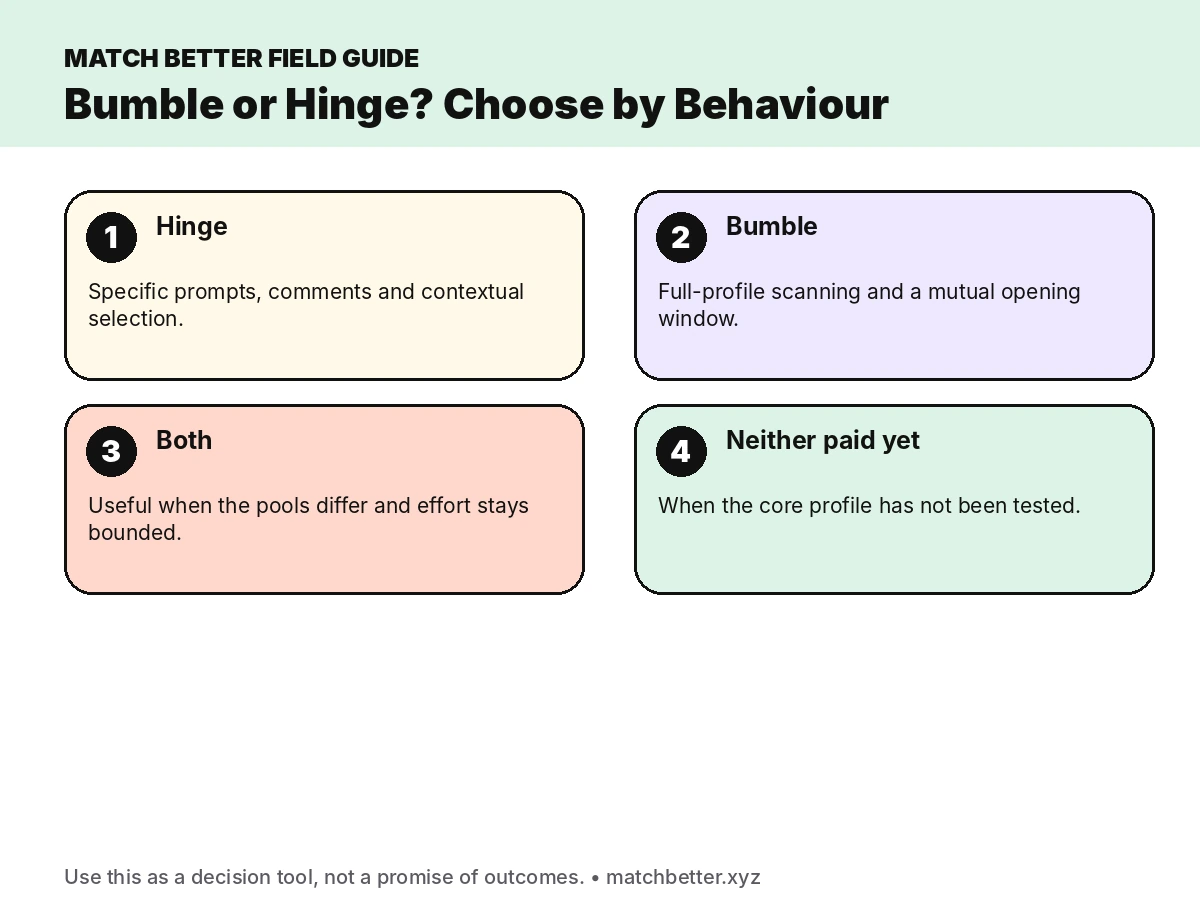
Which app fits which working style?
| You are strongest at… | Start with… | Reason |
|---|---|---|
| Specific observations and prompt-based humour | Hinge | Comments create context before matching |
| A strong six-photo story and concise bio | Bumble | The complete profile card carries more of the introduction |
| Carefully filtering a narrow, genuine requirement | Compare both | Local pool size may dominate product design |
| Replying quickly but writing poor first comments | Bumble, while improving openers | The mutual opening window gives another route—but profile hooks still matter |
| Getting matches but never asking for a date | Either | Your bottleneck is conversion, not app choice |
| Getting no matches on either | Neither subscription yet | Audit the source profile first |
The recommendation is a starting hypothesis. Your four-week data decides.
Action checklist
- Use equally current photos and the same honest intention on both.
- Adapt copy to each app’s format.
- Use Hinge comments on real profile hooks.
- Use Bumble’s current opening window rather than waiting.
- Track matches, substantive replies, dates and fit.
- Compare equal time periods and similar effort.
- Fix the weakest stage before switching apps.
- Buy only one feature to test one bottleneck.
- Cap app time and process existing matches.
- Choose based on your local evidence, not brand mythology.
Frequently asked questions
Is Bumble or Hinge better for men in India?
Neither is universally better. Hinge rewards prompt-specific comments; Bumble uses a broader profile card and current mutual opening window. City, age, intention and profile quality can matter more.
Is Hinge better for serious dating than Bumble?
Hinge’s format can expose compatibility details early, but both apps include stated intentions and neither guarantees serious behaviour. Evaluate the people and patterns available in your market.
Who messages first on Bumble now?
Under Bumble’s August 2026 conversation update, either person in a heterosexual match can send one opening message during the 72-hour opening window.
Should I use Bumble and Hinge at the same time?
Yes, when you can maintain thoughtful profiles and conversations without burnout. Use a time cap and compare outcomes over the same period.
Should I pay for both apps?
Not before you establish a free baseline. A subscription should test a specific access or visibility bottleneck, not compensate for an untested profile.
Sources and update notes
This guide was checked against official product documentation and primary research available on 9 September 2026. Dating-app features can change by market, account and app version.
- Bumble Support: How conversations start on Bumble
- Bumble Support: Using the Discover tab
- Bumble Support: Paid features and subscription plans
- Bumble Support: Sending Notes
- Hinge Help: Discover Feed
- Hinge Help: Likes and comments
- Hinge Help: Most Compatible
- Hinge Help: Standouts
- Hinge Help: Signals
- Hinge Help: Subscription and purchase benefits
Read next
Find your actual bottleneck
More swipes will not rewrite a weak profile. Take Match Better's free, private diagnosis and get a clear first fix: Start the free diagnosis.
Match Better is an independent education and coaching product for adults 18+. Bumble and Hinge are trademarks of their respective owners. No outcome is guaranteed. Never share a dating-app password with a coach or tool.