Hinge Photo Order for Men: Build a Profile That Tells a Story
Hinge profiles are consumed as a sequence of photos and prompts rather than a single image grid. Order therefore controls the story. A good sequence removes basic uncertainty early and creates comment opportunities as the person scrolls.
Key takeaways
- Lead with clear recognition and current appearance.
- Interleave prompts and photos so each adds new information.
- Use activity and social images in the middle for evidence.
- Finish with a distinctive comment hook.
- Treat Top Photo as data, not the author of your identity.
In this guide
- Design the scroll, not only the individual images
- Photo one: the current face
- Photo two: honest physical context
- Photos three and four: activity plus social proof
- Photo five: range and polish
- Photo six: the strongest comment hook
- Use Top Photo and comments as feedback
- A Hinge scroll that builds momentum
- Action checklist
- Frequently asked questions
Design the scroll, not only the individual images
On Hinge, a person can Like and comment on a specific photo or prompt. Every element is therefore both evidence and a possible conversation doorway. The order should alternate certainty, depth and interaction.
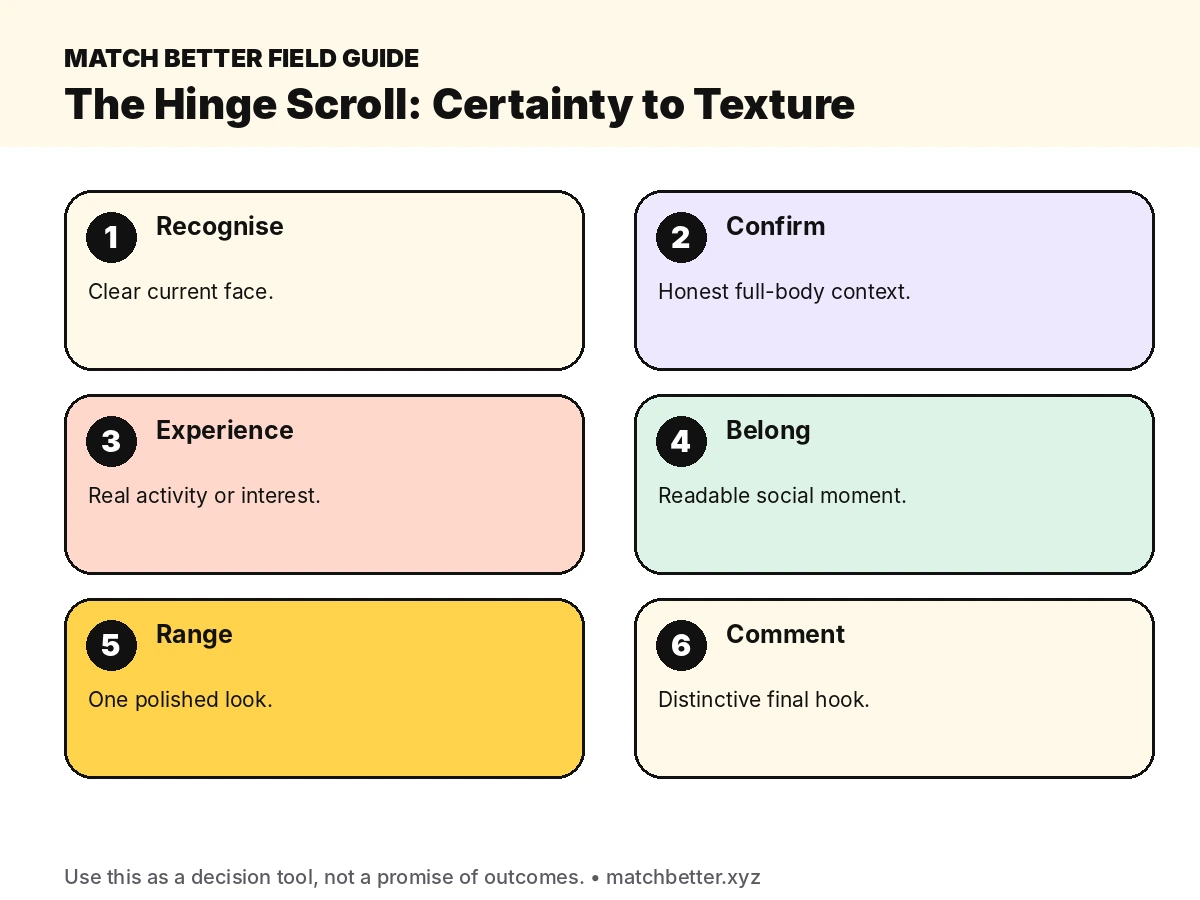
Start with a clear solo photograph. Follow with a prompt that adds voice rather than repeating appearance. Then show full-body context, another prompt, activity, social life and the remaining dimensions.
Preview the entire scroll. If the first half communicates only work and formal events, a warm final pet photo may arrive too late to change the impression.
Photo one: the current face
Use a solo waist-up or chest-up image in clean light. No sunglasses, distant crop or group. The first image should make the viewer comfortable that the profile is genuine and current.
Hinge’s profile refresh guide highlights Top Photo, which tests profile pictures and can automatically place the most popular image first. Use it when all candidates are accurate and suitable for the lead position.
If Top Photo chooses an old or unrepresentative image, remove that image rather than allowing short-term attention to damage first-date continuity.
Photo two: honest physical context
Place a full-body or three-quarter image near the top. Use fitted clothing, normal camera perspective and a believable setting. Avoid extreme angles that stretch height or hide build.
This photograph completes the basic visual introduction. A person should not need to scroll to the end to discover what you currently look like.
Pair it with a prompt that reveals a routine or value. The image handles appearance; the text handles personality.
Photos three and four: activity plus social proof
Show one repeatable interest where your face remains visible. Then use one small social image where you are obvious. These are not decoration. They prove the life described in prompts and create material for comments.
A Hinge Like can attach to a specific element, so make the activity understandable without a caption puzzle. A cooking image with the final dish and your expression can invite more than a dark photograph from across a football pitch.
Keep the social frame to a few people and avoid ambiguous couple energy or identifiable children.
Photo five: range and polish
Use a different visual register: evening portrait, jacket, linen, traditional clothing, event or clean formal look. This shows range after everyday accuracy has been established.
For Indian profiles, a strong wedding photograph can work here. Crop it so the image feels like a portrait, not a crowded album. Ensure grooming and body still match the current profile.
Do not use three formal images. One proves range; repetition starts to replace a life with an occasion.
Photo six: the strongest comment hook
Finish with a pet interaction, funny candid, niche project, unusual local find or travel moment that contains a story. The image should make a natural comment possible: “What happened next?” “Did you build that?” “Does the dog approve of anyone?”
Avoid ending on an object-only photograph. Hinge profiles exist to understand a person. Keep yourself visible or pair the object with a Photo Prompt that provides useful context.
A strong last element rewards the scroll and gives a hesitant viewer one final, easy way to interact.
Use Top Photo and comments as feedback
Top Photo can help test attention. Comments on particular images reveal which elements generate conversation. Track both. A photograph that receives many shallow compliments may be less useful than one that starts relevant conversations.
Do not change the entire order after three days. Run a stable two-week period, then swap one underperforming image or move a stronger hook earlier. Preserve enough consistency to learn.
The final standard is not “Which image got the most Likes?” It is “Which sequence creates accurate matches and conversations that feel easy to continue?”
A Hinge scroll that builds momentum
| Position | Element | Job |
|---|---|---|
| 1 | Clear solo lead photo | Recognition and warmth |
| 2 | Everyday-life prompt | Voice and routine |
| 3 | Full-body photo | Accurate physical context |
| 4 | Value prompt | Compatibility signal |
| 5 | Activity photo | Evidence and comment hook |
| 6 | Reply prompt | Low-effort interaction |
| 7 | Small social photo | Social context |
| 8 | Polished portrait | Range |
| 9 | Voice Prompt or Poll | Tone and participation |
| 10 | Personality wildcard | Final memorable hook |
The exact interface can change, but the sequence principle remains: remove doubt, reveal life, invite interaction.
Action checklist
- Lead with a current solo image.
- Show full-body context near the top.
- Interleave prompts that add new information.
- Use one real activity and one small social frame.
- Keep one polished or traditional-clothing image.
- End with a specific comment hook.
- Use Top Photo only with accurate candidates.
- Track conversation quality by element.
Frequently asked questions
What should the first Hinge photo be?
Use a clear, current solo portrait with visible eyes and a readable phone-size crop. The first image should establish identity and warmth.
What is Hinge Top Photo?
Hinge describes Top Photo as a feature that tests your pictures and can automatically put the most popular one first. Use it as performance feedback while protecting accuracy.
Can I use a wedding photo on Hinge?
Yes, one strong wedding portrait can show polish or traditional clothing. Place it after everyday context and ensure it still represents your current appearance.
Should I include a group photo?
One small, readable group can provide social context. Make sure you are obvious and avoid ambiguous images with an ex-partner or a large crowd.
Which Hinge photo should be last?
Use a memorable but accurate photo that invites a comment: pet, niche hobby, candid moment, project or interesting place with you clearly present.
Sources and update notes
This guide was checked against official product documentation and primary research available on 9 September 2026. Dating-app features can change by market, account and app version.
- Hinge: Profile refresh guide
- Hinge Help: Discover Feed
- Hinge Help: Likes and comments
- Cognitive Research: Principles and Implications — people often choose weaker profile images of themselves
Read next
Find your actual bottleneck
More swipes will not rewrite a weak profile. Take Match Better's free, private diagnosis and get a clear first fix: Start the free diagnosis.
Match Better is an independent education and coaching product for adults 18+. Bumble and Hinge are trademarks of their respective owners. No outcome is guaranteed. Never share a dating-app password with a coach or tool.