Bumble Algorithm 2026: What We Know, What We Do Not, and Safe Tests
“The algorithm” is often a convenient answer to every disappointing result because it cannot argue back. A better guide separates documented product behaviour from reasonable inference and internet folklore. You can then run tests on controllable inputs without pretending to reverse-engineer a private ranking system.
Key takeaways
- Bumble does not disclose a full ranking formula.
- Preferences and filters define who can appear.
- Discover uses profile information and prior matching patterns.
- Paid features can change visibility, not compatibility.
- Exact hidden scores and reset hacks are not confirmed.
In this guide
- What Bumble officially confirms
- What Bumble does not publicly confirm
- How the eligible pool changes your results
- How recommendations can learn from profile information and matches
- Safe tests that produce useful evidence
- Tests to avoid
- How to write about the algorithm responsibly
- Confirmed, reasonable inference or myth?
- Action checklist
- Frequently asked questions
What Bumble officially confirms
Bumble’s support material confirms several visible mechanisms. Basic and advanced filters curate the People tab. Discover highlights people with similar interests, goals and communities, and its recommended profiles use profile information and prior matches. Complete profiles, current photos, verification, prompts and interests are recommended for standing out.
Spotlight pushes a profile to more people for a period. Premium+ says it prioritises the subscriber in feeds and helps likes get seen sooner. These are product features, not evidence that the free experience is secretly impossible.
Bumble also advises balanced swipe behaviour and warns that repeatedly deleting and recreating accounts can hurt rather than help. Those are the clearest supported inputs available to a user.
What Bumble does not publicly confirm
Bumble does not provide an exact “desirability score,” a preferred number of daily right swipes, a required response time, a shadow-ban checklist or a guaranteed new-account boost formula in the support sources reviewed for this guide.
Anecdotes can reveal possibilities, but they cannot isolate cause. A person who recreated an account may also have replaced photos, changed city, joined during a busier week or altered preferences. The outcome does not prove the claimed mechanism.
Treat any precise claim without an official source or reproducible data as a hypothesis. Do not build the strategy around a number somebody invented for a video.
How the eligible pool changes your results
Before ranking matters, eligibility matters. Age, distance, verification and other filters can remove profiles from view. Advanced filters are available on Premium, and Bumble notes that the more filters you add, the fewer people you are likely to see.
Your own information can also be required for reciprocal filtering. For example, Bumble says you can use an advanced filter only when you have added the corresponding information to your profile.
When the app feels empty, loosen one non-essential restriction and observe. That is a pool test, not an “algorithm hack.” In India, distance needs special thought because a practical radius differs between dense neighbourhoods and spread-out metropolitan regions.
How recommendations can learn from profile information and matches
Bumble says Discover presents people with similar interests, goals and communities, and recommends four people daily based on profile information and who you matched with before. This supports a simple practice: complete fields honestly and choose interests that represent real life.
It does not support gaming identities or opening the profile to people you do not want merely to generate “signals.” A recommendation system is useful only when its inputs match your actual preferences and the people you would meet.
Use likes selectively enough to express preference, while remaining open to profiles that fit beyond one visual type.
Safe tests that produce useful evidence
Test the profile in the same city and approximate usage pattern for 14 days. Change one large input:
- lead photo,
- complete six-photo sequence,
- bio and prompts,
- one filter,
- verification,
- a short paid visibility feature after the profile is strong.
Track match rate directionally and include reply quality. Do not call every change an algorithm test; many are conversion tests. The distinction matters. A new lead photo may improve what people do after seeing you, not how often you are shown.
Tests to avoid
Do not automate likes, scrape profiles, create multiple accounts, impersonate someone, misstate identity or repeatedly reset the account. These tactics can violate platform rules, damage safety and produce bad data.
Avoid extreme swiping experiments that include people you would never meet. A match is not a vanity unit; it starts an interaction with another person. Manipulative volume creates poor fit and can harm other users’ experience.
The safest “algorithm strategy” is boring: accurate complete profile, clear photos, reasonable filters, respectful activity and patient iteration.
How to write about the algorithm responsibly
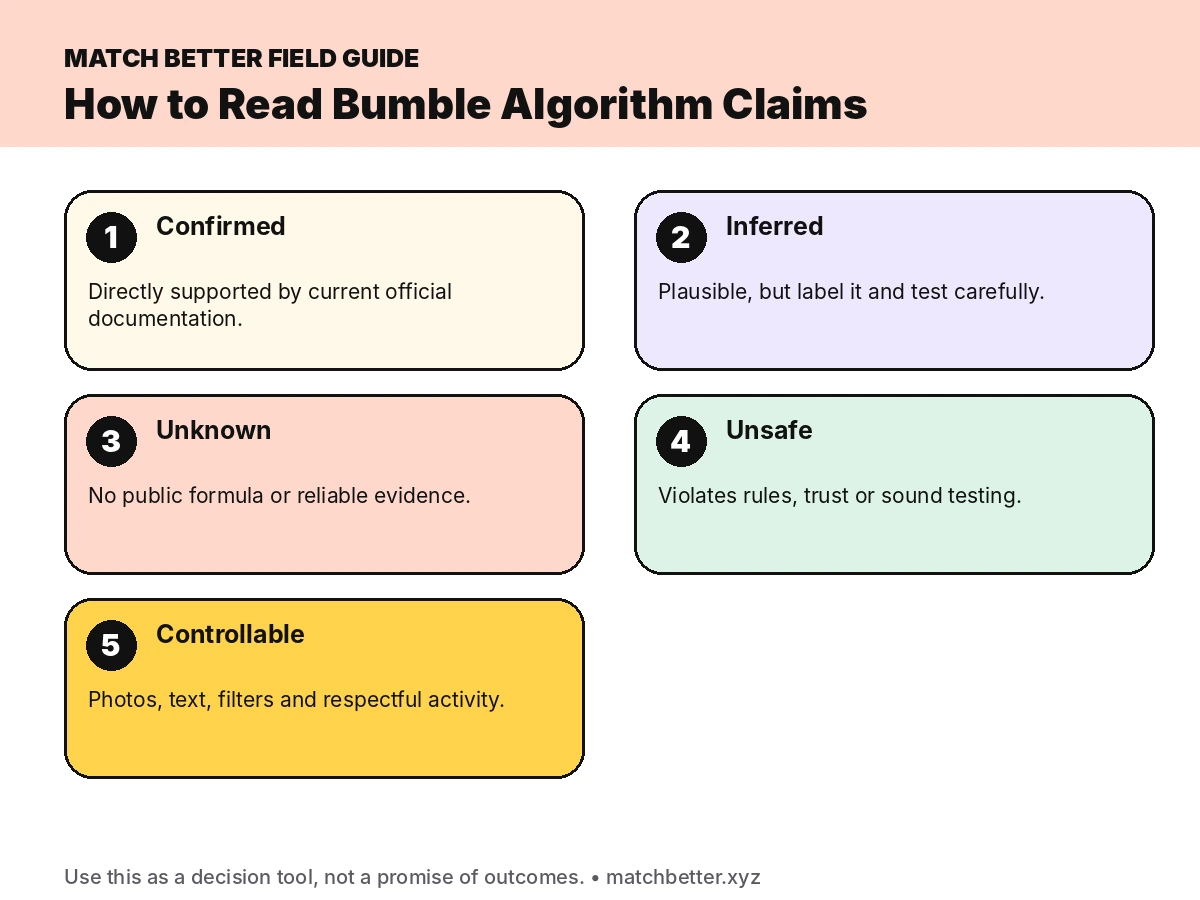
For AEO and SEO, use a confirmed / likely / unknown framework. Link directly to official documentation, include the review date and update the page when the app changes. Do not quote unsupported match-rate statistics.
Google’s current guidance for generative search emphasises useful, original, people-first material rather than AEO tricks. A transparent algorithm article has a better chance of earning trust than an invented list of secret ranking factors.
The most valuable first-party addition is anonymised testing methodology: what changed, what stayed constant and what outcome was observed. Do not present a small sample as universal truth.
Confirmed, reasonable inference or myth?
| Claim | Status | Why |
|---|---|---|
| Filters change who appears | Confirmed | Bumble documents basic and advanced filters |
| Discover uses profile information and prior matches | Confirmed | Stated in Bumble’s Discover support page |
| Spotlight increases visibility | Confirmed | Described as pushing the profile to more people |
| Premium+ prioritises profiles in feeds | Confirmed | Listed as a plan benefit |
| Everyone has a secret public score of exactly 1–100 | Unconfirmed | No official formula published |
| Deleting every week resets reach | Unsafe myth | Bumble advises against repeated recreation |
| A clearer lead photo can improve matches | Reasonable conversion hypothesis | It changes how viewers respond, not necessarily distribution |
Action checklist
- Look for a current official source before repeating a ranking claim.
- Separate eligibility, visibility and profile conversion.
- Complete profile fields honestly.
- Review filters before blaming ranking.
- Test one controllable input for 14 days.
- Avoid resets, automation and mass-like experiments.
- Record fit and replies, not only matches.
- Add a visible update date to every algorithm article.
Frequently asked questions
Does Bumble have an attractiveness score?
Bumble does not publish a complete ranking formula in the official support pages reviewed here. Precise claims about a universal attractiveness score should be treated as unverified.
Does Bumble punish swiping right on everyone?
Bumble recommends balanced swipe behaviour, but it does not publish an exact ratio or penalty formula. Read profiles and like people you would genuinely meet.
Does deleting Bumble reset the algorithm?
There is no official guarantee of a beneficial reset. Bumble specifically advises against repeatedly deleting and recreating profiles.
Do paid plans change the algorithm?
Paid features can change access or visibility. Bumble lists Spotlight and Premium+ prioritisation, but payment does not override other people’s preferences or guarantee matches.
How often should I update this article?
Review it at least quarterly and immediately after a major Bumble product update. The conversation system changed in August 2026, showing how quickly old advice can become inaccurate.
Sources and update notes
This guide was checked against official product documentation and primary research available on 9 September 2026. Dating-app features can change by market, account and app version.
- Bumble Support: Standing out on Bumble
- Bumble Support: Using the Discover tab
- Bumble Support: Using filters to set preferences
- Bumble Support: Paid features and subscription plans
- Bumble Support: Uploading profile photos and videos
- Google Search Central: Optimizing for generative AI features
- Google Search Central: Creating helpful, reliable, people-first content
Read next
Find your actual bottleneck
More swipes will not rewrite a weak profile. Take Match Better's free, private diagnosis and get a clear first fix: Start the free diagnosis.
Match Better is an independent education and coaching product for adults 18+. Bumble and Hinge are trademarks of their respective owners. No outcome is guaranteed. Never share a dating-app password with a coach or tool.