Why Am I Not Getting Matches on Dating Apps? A Diagnostic Guide for Indian Men
You can have a decent job, be perfectly dateable in real life and still get almost nothing on an app. That does not prove that “the algorithm hates you.” It usually means the profile is losing people at a specific stage. The useful question is not “What secret hack am I missing?” It is “Where does my funnel break?”
Key takeaways
- Separate visibility problems from profile-conversion problems.
- Your first photo has one job: make the right person stop and look closer.
- Generic bios and repetitive photos give matches nothing to respond to.
- Do not repeatedly delete and recreate accounts as a shortcut.
- Run controlled tests before spending on Boosts, Spotlights or subscriptions.
In this guide
- Start with the dating-app funnel, not a conspiracy
- The five bottlenecks that cause most low-match profiles
- Run a twenty-minute profile autopsy
- Use a clean fourteen-day test
- When paying can help, and when it only magnifies the problem
- Three common profiles and the likely diagnosis
- Action checklist
- Frequently asked questions
Start with the dating-app funnel, not a conspiracy
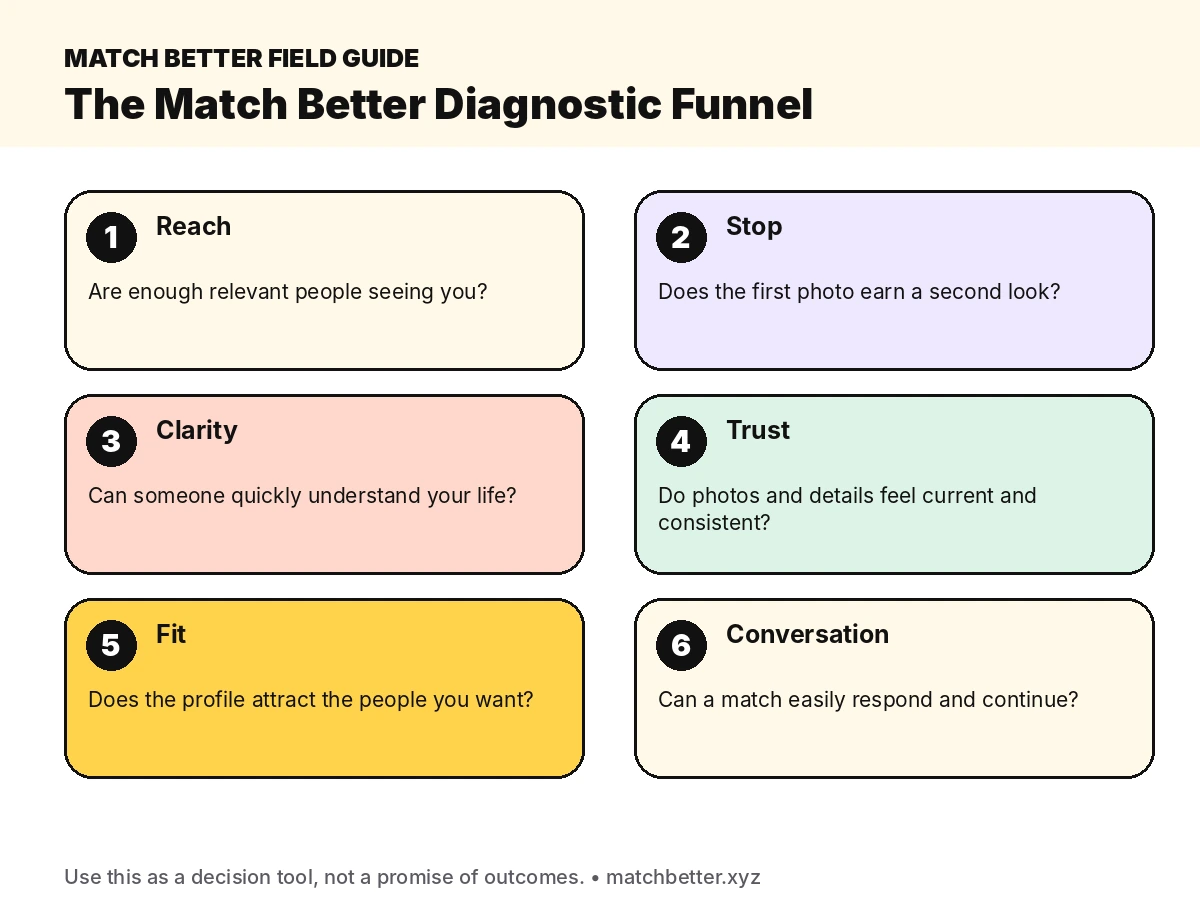
A match requires several things to happen in order. A relevant person must be shown your profile, notice the first photo, inspect enough of the profile to understand you, feel some degree of fit, and then act. A weak result at the end does not tell you which earlier step failed.
Use three observations. No incoming likes and very few outgoing matches usually points to visibility, first-photo or overall-profile problems. Some matches but weak replies points more toward positioning, openers or a mismatch between the profile and the conversation. Good conversations that never become plans is a conversion problem, not a photo problem.
Treat this like a funnel. You are not trying to impress everyone. You are trying to make your intended audience understand you quickly enough to choose. That shift stops random rewriting and gives every change a purpose.
The five bottlenecks that cause most low-match profiles
| Bottleneck | What it looks like | First fix |
|---|---|---|
| Reach | The pool is extremely small or filters are rigid | Review age, distance and dealbreakers |
| First-photo stop | Almost nobody seems to engage | Replace the lead image with a clear, warm solo shot |
| Profile clarity | Photos look fine but the profile says little | Add specific interests, routines and intentions |
| Trust | Old, filtered, hidden or inconsistent photos | Use recent photos, verification and consistent grooming |
| Fit | You attract the wrong people or nobody relevant | Align photos, prompts and dating intention |
Bumble itself recommends complete profiles, current clear photos, verification, prompts, realistic filters and balanced behaviour. It also warns that repeatedly deleting and recreating profiles can hurt rather than help. Those are documented basics, not magic. Match Better’s contribution is deciding which one matters first for your profile.
Run a twenty-minute profile autopsy
Open your profile as another person would see it and cover the text with your hand. In five seconds, can someone tell which photo is you, see your face, estimate your current appearance and sense anything beyond work? Next, cover the photos and read only the words. Is there a concrete detail that could start a conversation, or is it a list such as “foodie, traveller, music lover”?
Then check continuity. If the first photo looks formal, the second is four years old, the third is a distant trekking silhouette and the fourth is a wedding group, the viewer has to solve a puzzle. The profile should feel like one current person across different contexts.
Finally, check the ask. A profile that says it wants a serious relationship but communicates only nightlife and jokes may create uncertainty. You do not need to sound solemn. You do need to make your intention believable.
Use a clean fourteen-day test
Change the largest suspected bottleneck and leave everything else mostly stable. If the lead photo is weak, replace it but do not simultaneously rewrite every prompt, buy a subscription and widen the distance to 100 kilometres. You would not know what helped.
For 14 days, use the app consistently at normal times, send selective likes to people you would genuinely meet, and add a specific comment where the product allows it. Record simple numbers: outgoing likes, matches, replies and conversations that reached a plan. Exact app impression data may not be available, so use directional evidence rather than pretending you have laboratory precision.
At the end, keep a change only if it improves the quality or quantity of the next stage. A photo that brings more matches but a worse fit is not automatically better.
When paying can help, and when it only magnifies the problem
Paid reach is useful when the profile already converts reasonably and you want faster exposure to a larger relevant pool. It is a poor first move when the opening photo is unclear or the profile is empty. A Spotlight or Boost can show a weak profile to more people; it cannot make the profile clearer.
Before paying, pass three tests: your first photo is current and obvious, your six-photo set has variety, and your text gives at least two easy conversation hooks. Then purchase one short experiment, note the starting baseline and judge it by relevant matches, not raw likes.
Also remember that app features and prices vary by market, account and time. Use the latest in-app information before buying. The strategic rule remains stable: repair conversion before purchasing distribution.
Three common profiles and the likely diagnosis
| Situation | Likely diagnosis | Better first move |
|---|---|---|
| Six good-looking photos, but five are from the same wedding | Repetition and unclear everyday identity | Keep one formal shot; add daily-life, activity and social context |
| Detailed prompts, but the first image is a distant group photo | First-photo stop problem | Lead with a bright solo image where the face is obvious |
| Matches arrive, then conversations die after “Hey, what’s up?” | Messaging problem | Use one profile detail, add a small opinion and ask an easy question |
| Strong profile in a small radius with many rigid filters | Reach problem | Relax one non-essential filter for a two-week test |
| Many matches, almost none with compatible intentions | Positioning and selection problem | State intention clearly and swipe more selectively |
Action checklist
- Classify the problem: no likes, no matches, dry replies or no dates.
- Replace an unclear first photo before changing minor prompt wording.
- Use four to six recent photos with distinct roles.
- Add two specific conversation hooks to the bio or prompts.
- Check distance, age and advanced filters for accidental over-restriction.
- Verify the profile where available.
- Run one major change for 14 days.
- Judge paid reach only after the profile passes the basic audit.
Frequently asked questions
Does getting no matches mean I am unattractive?
No. An app measures how a small set of photos, words, settings and behaviours perform in a particular pool. It does not measure your full attractiveness or relationship potential. Start by improving clarity and fit before making a global judgment about yourself.
Should I delete my account and start again?
Not as a routine tactic. Bumble explicitly advises against repeatedly deleting and recreating profiles. Fix the profile, settings and usage first. Delete only when you genuinely want to leave or rebuild for a legitimate reason.
How long should I test a new profile?
Fourteen days is a practical editorial recommendation, not an app rule. It is long enough to avoid judging one quiet evening and short enough to iterate. Keep the app, city and behaviour reasonably stable during the test.
Should I buy Premium when I get no matches?
Usually not as the first move. Paid features increase access or visibility; they do not repair weak photos or generic positioning. Audit the profile, then test a paid feature against a baseline.
Can Match Better guarantee more matches?
No. Nobody can guarantee another person’s choice. The goal is to improve the inputs you control: profile clarity, photos, communication, selection and consistency.
Sources and update notes
This guide was checked against official product documentation and primary research available on 9 September 2026. Dating-app features can change by market, account and app version.
- Match Better live website and product positioning
- Bumble Support: Standing out on Bumble
- Bumble Support: Uploading profile photos and videos
- Bumble Support: Using filters to set preferences
- Hinge Help: Subscriber experience
- Google Search Central: Creating helpful, reliable, people-first content
Read next
Find your actual bottleneck
More swipes will not rewrite a weak profile. Take Match Better's free, private diagnosis and get a clear first fix: Start the free diagnosis.
Match Better is an independent education and coaching product for adults 18+. Bumble and Hinge are trademarks of their respective owners. No outcome is guaranteed. Never share a dating-app password with a coach or tool.