Dating Profile Checklist for Men: A 25-Point Audit Before You Swipe
Most men edit a profile by asking, “Is this line funny?” That is too narrow. A profile can contain one funny line and still fail because the lead photo is confusing, every image is formal, the intention is vague or there is no safe way to start a conversation. This audit turns the profile into 25 visible decisions.
Key takeaways
- Score the profile by category instead of arguing about one photo.
- A recognisable current face matters before clever writing.
- Every photo should perform a different job.
- Specific details create response opportunities.
- Fix the weakest category before polishing an already-strong one.
In this guide
- How to score the audit
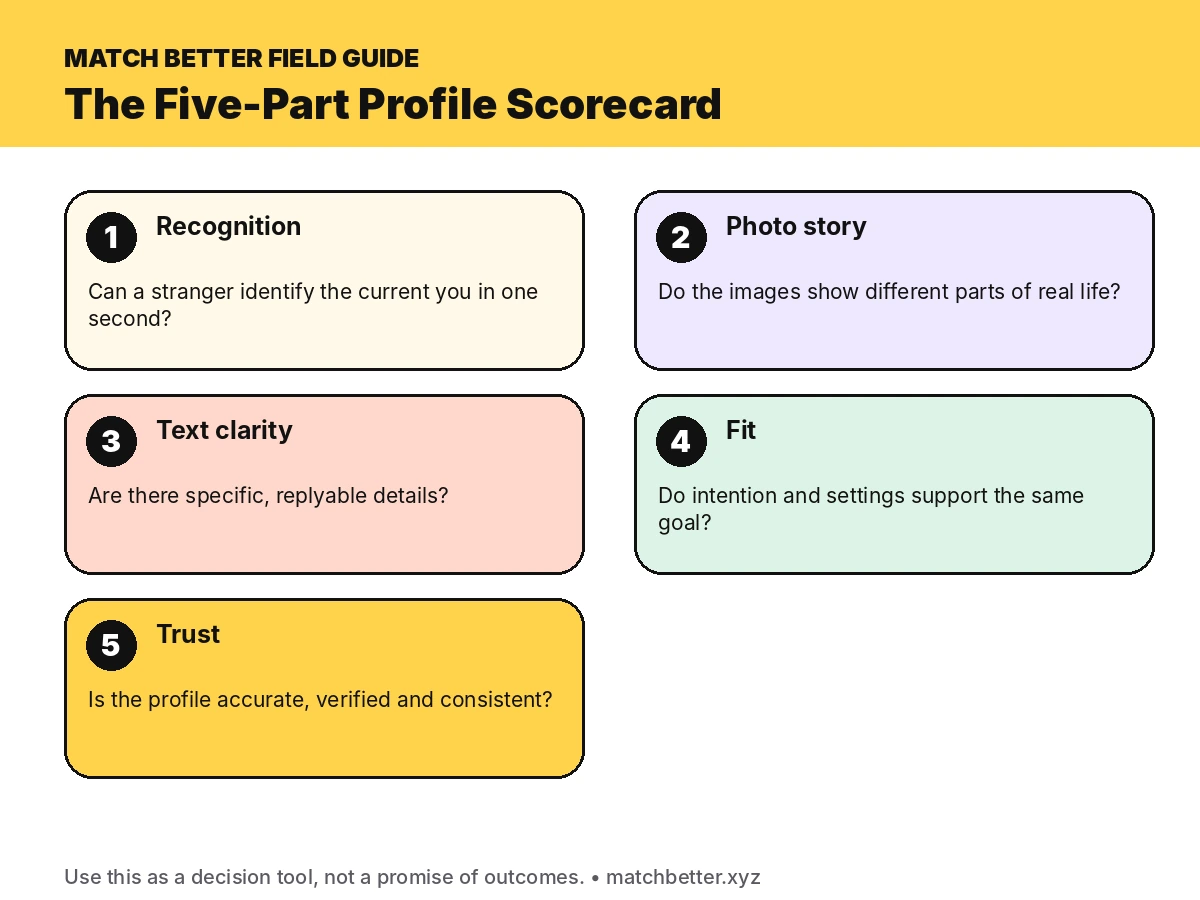
- Category one: immediate recognition and first impression
- Category two: the six-photo story
- Category three: bio and prompt clarity
- Category four: intention, settings and fit
- Category five: trust and conversation readiness
- How to interpret your score
- Action checklist
- Frequently asked questions
How to score the audit
Give yourself one point only when an item is clearly true. “Probably” and “my friends know what I look like” do not count. Use the profile preview, not the edit screen, because ordering and cropping can change how the profile feels.
Score each category out of five. A total above 21 is publishable but still testable. A score from 16 to 20 has one or two meaningful leaks. Below 16, stop spending on visibility and rebuild the basics. The total is less important than the pattern. A profile with 5/5 text and 1/5 first-impression photos should work on photos first.
Ask two people who match the kind of person you hope to date to score it independently. Research on profile-image selection suggests people are not always the best judges of their own strongest photo, so external feedback is useful when it is specific rather than polite.
Category one: immediate recognition and first impression
- The first photo contains only you. No one must identify you in a group.
- Your eyes and face are visible. Sunglasses, helmets and heavy shadows are not doing the introduction.
- The image is recent. Hair, beard, weight and general appearance match today.
- The crop works on a phone. Your face is large enough without becoming an extreme close-up.
- The expression feels approachable. It can be calm or confident; it should not look like an ID card or forced performance.
These five items decide whether the rest of the profile gets a chance. Bumble currently recommends clear, well-lit photos where the face is visible and says four to six photos work best. Hinge also offers Top Photo to test which image performs best, but an automated ranking should complement, not replace, human judgment about accuracy and fit.
Category two: the six-photo story
- At least four photos are usable and distinct. More is not automatically better, but one or two images provide too little evidence.
- One image shows your full build naturally. It should be honest, well-fitted and not a gym changing-room mirror.
- One image shows a real activity or interest. Cooking, running, playing music, design, reading or a sport is stronger than holding a random prop.
- One image provides social context. You are immediately identifiable and the image is not dominated by a large group.
- The set contains visual variety. Different framing, clothing and context, while still looking like the same current person.
A common Indian profile has six technically good photographs from weddings. That proves you own formal clothes, but it does not reveal Tuesday evening, Sunday morning or the life a date might enter.
Category three: bio and prompt clarity
- The bio contains a concrete detail. Replace “foodie” with the food ritual, place or opinion.
- At least one prompt reveals a value or routine. Not every answer needs to be a joke.
- At least one prompt gives an easy reply path. A choice, light debate, recommendation or invitation works.
- The text sounds like speech. Remove corporate language, motivational quotes and copied internet lines.
- The profile avoids negativity. No list of what women should not be, no complaints about apps and no defensive “prove me wrong.”
Originality research in online dating profiles points in a useful direction: specific, distinctive language contributes more to impression formation than generic self-description. The goal is not literary brilliance. It is recognisable detail.
Category four: intention, settings and fit
- Your dating intention is accurate. Do not select a serious goal while writing a profile that communicates the opposite.
- Age and distance ranges are realistic for your city and mobility. A narrow radius in a spread-out city may create artificial scarcity.
- Only true dealbreakers are hard filters. Preferences are not all dealbreakers.
- Basic details are complete and current. Work, education, location, smoking, drinking and other fields should not contradict the profile.
- Your likes are selective but not impossible. You are choosing people you would actually meet, not only the most polished profiles in the feed.
Apps use stated preferences and activity to shape recommendations. Hinge says Discover recommendations are based on mutual fit, while Bumble notes that too many filters can reduce who appears. There is no benefit in engineering a tiny pool and then blaming the profile.
Category five: trust and conversation readiness
- Verification is completed where available. It is not proof of compatibility, but it reduces one layer of uncertainty.
- No photo creates a misleading age or appearance gap. Remove the one image that gets compliments but no longer represents you.
- No identifiable stranger is used as a prop. Crop or blur children and avoid ambiguous couple-style images.
- There are at least two obvious opener hooks. A match should not need to invent a topic from nothing.
- The profile can survive the first date. The energy, interests and appearance promised online are recognisably yours in person.
This final category protects long-term conversion. A profile is not successful because it extracts a right swipe. It is successful when it creates an accurate first impression that can continue into a comfortable conversation and an honest meeting.
How to interpret your score
| Score | Interpretation | What to do next |
|---|---|---|
| 22–25 | Strong foundation | Test order, one prompt and selective messaging |
| 18–21 | Functional with a visible leak | Fix the lowest category before paying for reach |
| 14–17 | Too much uncertainty | Rebuild first photo, variety and text hooks |
| 0–13 | The app cannot understand or present you well | Pause active swiping for a weekend and rebuild from the audit |
Example: A Bengaluru software engineer scores 5/5 on recognition, 2/5 on photo story, 4/5 on text, 4/5 on settings and 4/5 on trust. He should not spend two hours rewriting a decent prompt. His next move is to replace repetitive office and wedding photographs with an activity shot, a relaxed full-body image and one obvious social context.
Action checklist
- Score all 25 items without giving partial credit.
- Ask two relevant reviewers to score independently.
- Identify the lowest category, not just the lowest single item.
- Fix first-photo recognition before small copy edits.
- Remove old or misleading photos.
- Create two obvious conversation hooks.
- Preview the profile on a phone after reordering.
- Repeat the audit after 14 days of controlled testing.
Frequently asked questions
How many photos should a man use on a dating profile?
Use enough current, distinct photos to remove uncertainty. Bumble’s current guidance says four to six work best and allows up to six. Hinge profiles are also built around a fuller visual-and-prompt story. Quality and variety matter more than filling every slot with weak images.
Who should review my dating profile?
Choose people who will be honest and who understand the kind of person you want to meet. Ask specific questions such as “Which image would you lead with?” and “What do you think my weekends look like?” rather than “Is this good?”
Should every prompt be funny?
No. A profile made entirely of jokes can hide the person. Use a mix: one playful answer, one specific lifestyle detail and one value or intention that creates fit.
Is verification necessary?
It may be optional depending on app and market, but it can reduce avoidable uncertainty. Verification does not prove character or compatibility, so keep normal safety judgment.
How often should I audit the profile?
Run the full audit before launch, after a major appearance or lifestyle change, and every three months. Feature-dependent details should also be reviewed when an app changes its product.
Sources and update notes
This guide was checked against official product documentation and primary research available on 9 September 2026. Dating-app features can change by market, account and app version.
- Bumble Support: Uploading profile photos and videos
- Bumble Support: Standing out on Bumble
- Bumble Support: Using filters to set preferences
- Bumble Support: Photo verification
- Hinge Help: Discover Feed
- Hinge: Profile refresh guide
- Cognitive Research: Principles and Implications — people often choose weaker profile images of themselves
Read next
Find your actual bottleneck
More swipes will not rewrite a weak profile. Take Match Better's free, private diagnosis and get a clear first fix: Start the free diagnosis.
Match Better is an independent education and coaching product for adults 18+. Bumble and Hinge are trademarks of their respective owners. No outcome is guaranteed. Never share a dating-app password with a coach or tool.