Dating App Safety for Men in India: Scams, Privacy and Safer First Dates
Men are not exempt from romance scams, extortion, theft, impersonation or unsafe dates. Embarrassment is one reason victims wait. The better position is ordinary caution: verify enough, protect private information, keep control of money and transport, and leave at the first serious boundary violation. Safety is not paranoia. It is preserving your ability to choose.
Key takeaways
- No legitimate early match needs money, OTPs or investment access.
- Verification reduces one risk but does not prove character or intent.
- Rapid migration off-app can remove useful reporting and safety context.
- First dates should be public, independently reachable and easy to leave.
- For cyber-financial fraud in India, act quickly and preserve evidence.
In this guide
- The highest-value rule: separate romance from money
- Common red flags—not automatic guilt, but reasons to pause
- Use app verification correctly
- Protect privacy before meeting
- Plan a safer first date
- What to do when something feels wrong
- Safety boundaries that are not accusations
- Pause, verify, leave or report?
- Action checklist
- Frequently asked questions
The highest-value rule: separate romance from money
Romance scams often build trust or urgency before requesting value. The request may be direct—an emergency transfer—or disguised as an investment opportunity, ticket, customs fee, medical bill, recharge, gift card or “temporary” UPI payment.
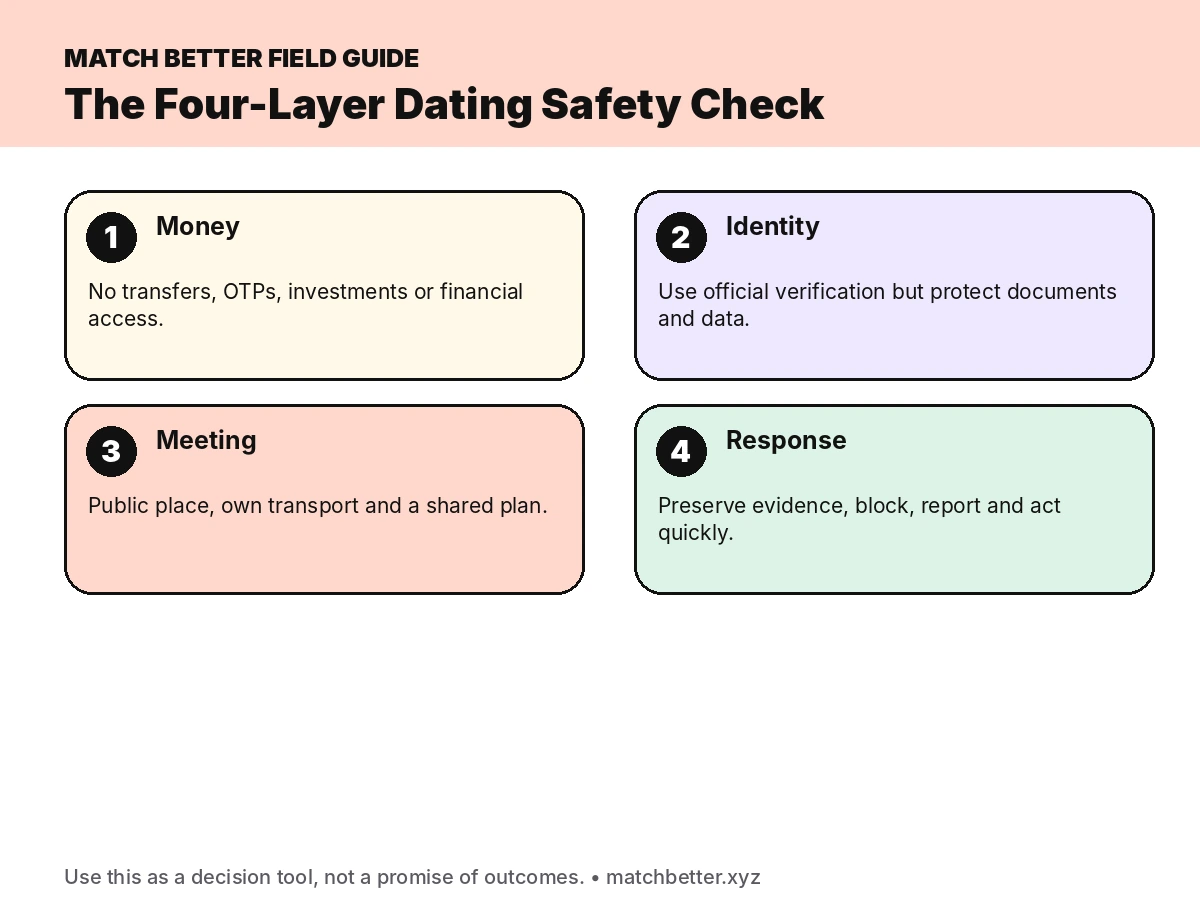
Do not send money to someone you have not built substantial real-world trust with. Never share an OTP, PIN, card security code, remote-access permission or banking login. Do not move cryptocurrency or open an investment account because a match claims expertise.
The US Federal Trade Commission’s romance-scam guidance describes common patterns such as moving the relationship quickly and asking for money. The principle travels well: affection is not financial due diligence.
Common red flags—not automatic guilt, but reasons to pause
Look for clusters rather than one awkward detail:
- the person refuses any live verification but pushes intense intimacy;
- stories, age, location or work details keep changing;
- there is always a crisis preventing a meeting;
- they pressure you to leave the app immediately;
- they send suspicious links or ask you to install software;
- they ask for private photos, then threaten exposure;
- they direct you to trading, betting or “guaranteed return” platforms;
- they insist on one venue where staff or pricing feels coercive;
- they become angry when you set a basic safety boundary.
A real person can still be unsafe, and a verified profile can still lie. Red flags are prompts to slow down, verify and retain control.
Use app verification correctly
Photo or identity verification can reduce impersonation risk by checking whether a user resembles submitted photos or an approved document. It does not conduct a background check or certify intentions.
Bumble currently offers photo verification and an India-specific ID-verification process. Its support material notes which physical documents are accepted and warns that DigiLocker copies are not accepted in that flow at the time of review. Product requirements may change, so follow the current in-app instructions rather than sending documents to another user.
Never share your Aadhaar, passport, driving licence or verification selfie directly with a match. Verification should happen only inside the official app process.
Protect privacy before meeting
Keep your surname, exact home address, office location and daily routine private until trust develops. Review what your photos reveal: building signs, vehicle numbers, office badges, school names and live location can disclose more than intended.
Use in-app voice or video features where available before sharing a phone number. If you move to another messenger, tighten profile-photo and last-seen visibility. Never click login links sent in chat; open the official app independently.
For intimate images, the safest choice is not to send identifiable content to someone you have not established trust with. Threats to publish images are abuse, not a debt you must pay.
Plan a safer first date
Choose a busy, ordinary public venue that you can independently locate and leave. Avoid a first meeting at either person’s home, an isolated drive, hotel room or unfamiliar venue selected under pressure.
Tell a trusted person the name shown on the profile, venue and expected return time. Share live location during the meeting when appropriate. Use your own transport in both directions and keep enough battery and payment capacity to leave.
Watch drinks and belongings. Set a personal alcohol limit before arriving. If the venue changes unexpectedly or a situation feels coercive, leave. Politeness is not more important than safety.
What to do when something feels wrong
End the interaction inside the app, block where necessary and use the platform’s report function. Preserve screenshots, profile details, payment records, phone numbers, URLs and timestamps before the account disappears. Do not threaten a scammer with retaliation or arrange a confrontation.
For suspected cyber-financial fraud in India, the government directs victims to helpline 1930 and the National Cyber Crime Reporting Portal. Speed matters because financial systems may have a better chance of acting on recent transactions. Contact your bank or payment provider immediately as well.
For immediate physical danger, contact local emergency services and move to a safe public location. Legal procedures vary; this guide is practical education, not legal advice.
Safety boundaries that are not accusations
You do not need to prove someone is a scammer before saying:
- “I keep money and investments separate from dating.”
- “I do not share OTPs or identity documents.”
- “I prefer to stay in the app until we have met.”
- “For a first date, I meet only in a public place.”
- “That venue does not work for me; let us choose a normal café.”
- “I am not comfortable sending that photo.”
A trustworthy person may have preferences, but they can respect a clear safety boundary. Pressure, ridicule or anger after a basic boundary is itself information.
Pause, verify, leave or report?
| Situation | Best next action |
|---|---|
| Match asks to move to WhatsApp after a good conversation | Optional; protect privacy and keep enough app context to report |
| Match refuses video but agrees to a public meeting | Proceed only if comfortable, with full first-date safeguards |
| Match asks for ₹2,000 in an “emergency” | Do not send; stop and report if deceptive or coercive |
| Match offers a guaranteed crypto strategy | Do not click, deposit or share financial information |
| Venue feels coercive or prices are hidden | Leave immediately and use your own transport |
| Money has already been transferred in suspected fraud | Contact bank/payment provider, call 1930 and report on cybercrime.gov.in promptly |
Shame delays action. Evidence and speed are more useful.
Action checklist
- Keep money and investment decisions separate from dating.
- Never share OTPs, PINs, card codes or banking access.
- Do not send identity documents to a match.
- Use official in-app verification only.
- Keep early communication in-app or privacy-restricted.
- Avoid identifiable intimate images.
- Meet in a busy public place with your own transport.
- Share the plan with a trusted person.
- Leave when a boundary is pressured.
- Preserve evidence before blocking.
- For suspected cyber-financial fraud in India, contact 1930 and cybercrime.gov.in promptly.
Frequently asked questions
Can men be targeted by dating app scams?
Yes. Financial scams, extortion, impersonation, theft and unsafe meetings can target anyone. Report quickly rather than letting embarrassment delay action.
Does a verified Bumble or Hinge profile mean it is safe?
No. Verification can reduce impersonation risk, but it does not prove character, intentions, relationship status or future behaviour.
What should I never send to a dating-app match?
Do not send money, OTPs, banking credentials, remote-access permissions, gift cards, cryptocurrency, identity documents or identifiable intimate images under pressure.
Where can I report an online dating scam in India?
For suspected cybercrime or cyber-financial fraud, use the National Cyber Crime Reporting Portal and helpline 1930. Contact your bank or payment provider immediately when money is involved.
What is a safe first-date plan?
Meet at a busy public venue, use independent transport, share the plan with a trusted person, protect private addresses and leave whenever you feel unsafe.
Sources and update notes
This guide was checked against official product documentation and primary research available on 9 September 2026. Dating-app features can change by market, account and app version.
- Government of India: National Cyber Crime Reporting Portal and helpline 1930
- US Federal Trade Commission: What to know about romance scams
- Bumble Support: Safety features
- Bumble Support: Reporting someone
- Bumble Support: ID verification in India
- Bumble Support: Photo verification
Read next
Find your actual bottleneck
More swipes will not rewrite a weak profile. Take Match Better's free, private diagnosis and get a clear first fix: Start the free diagnosis.
Match Better is an independent education and coaching product for adults 18+. Bumble and Hinge are trademarks of their respective owners. No outcome is guaranteed. Never share a dating-app password with a coach or tool.