Dry Replies, Slow Replies and Ghosting: What to Do on Dating Apps
A three-hour delay can feel enormous when you are staring at a match. It is also nearly meaningless. People work, travel, mute notifications, date other people, lose momentum and change their minds. The useful skill is separating uncertainty from a repeated pattern—and preserving your dignity without turning the other person into a villain.
Key takeaways
- One message is noise; repeated effort imbalance is a signal.
- Slow and thoughtful can be healthier than fast and empty.
- Use one reset message, not a campaign.
- Do not use another platform to bypass silence.
- A match creates an opportunity, not an obligation to continue.
In this guide
- Define the three patterns
- Check your own last message first
- Use the one-reset rule
- Do not diagnose from read receipts or online status
- How to respond to repeated dry replies
- What not to send after silence
- Protect confidence with a portfolio mindset
- What to do in five common situations
- Action checklist
- Frequently asked questions
Define the three patterns
Dry replies are repeated minimal answers—“haha,” “nice,” “yeah”—with little information, no follow-up and no visible effort to continue.
Slow replies describe timing only. A person may respond once a day with a thoughtful paragraph and real questions. That is slow, not necessarily disinterested.
Ghosting is sustained silence after an active conversation or plan, without a closing message. People use the word for everything from an unanswered opener to disappearing after several dates; the emotional impact is different in each case.
Definitions matter because the response should match the level of relationship and evidence. An unopened first message does not require closure from a stranger.
Check your own last message first
Before assuming rejection, inspect whether your message was easy to answer. Did it contain a specific hook? Did you ask three questions? Did you send only “haha”? Did you abruptly introduce sex, ask for personal data or push a date after hesitation?
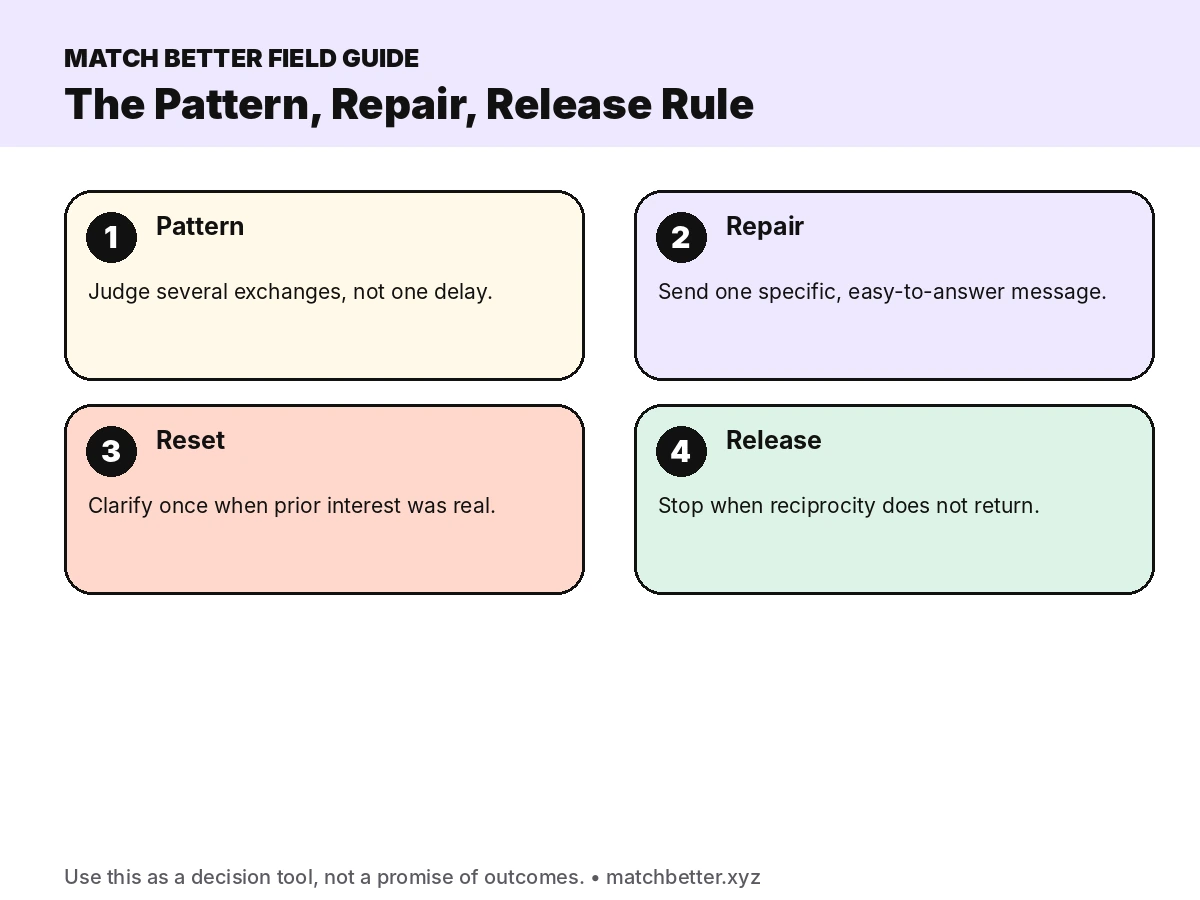
Rewrite the next turn using Answer–Add–Ask. Pick one earlier thread and make it concrete:
“Your story about learning guitar stayed with me. What is the first song that finally sounded recognisable?”
This is a repair, not an audition. Improve once. If reciprocity does not return, more craft will not solve the underlying interest gap.
Use the one-reset rule
A reset is appropriate when the conversation previously had real energy, your last message did not need an answer, or life plausibly interrupted the thread. Send one message after a reasonable pause based on the established pace.
Light reset: “This week seems to have eaten both our schedules. How did the presentation go?”
Direct reset: “I have enjoyed talking. Still interested in continuing, or has the timing passed? Either is okay.”
Plan reset: “Checking once before I make other plans—are we still on for Sunday?”
After that, stop. The reset gives clarity; repeated follow-ups create pressure.
Do not diagnose from read receipts or online status
Bumble states that standard chats do not show read receipts. Other apps may expose different indicators, but a “seen” status still cannot tell you motive. Someone can open a message at work, forget, feel uncertain, be overwhelmed or choose not to answer.
Avoid surveillance habits: checking distance changes, searching social media activity or measuring every interval. These behaviours amplify anxiety without creating reliable information.
Use observable relationship behaviour over time: Do they contribute? Do they follow through? Do they repair a missed plan? Those signals matter more than whether they were online at 11:42 p.m.
How to respond to repeated dry replies
Try one message that changes the format from fact collection to opinion, story or plan.
“Rapid-fire questions are making this feel like an interview. Choose one: best meal this month, worst travel mistake or the hill you will defend forever?”
If the answer remains minimal and contains no curiosity, match the level of investment and step away. Do not send “you are dry,” which criticises rather than clarifies. You can close cleanly: “I do not think the conversation is clicking, but good luck here.”
Sometimes two decent people simply have incompatible texting energy. That is useful information, not a problem to defeat.
What not to send after silence
Do not send:
- “Why did you match if you will not reply?”
- “I guess nice guys finish last.”
- a string of question marks;
- sexual or insulting retaliation;
- messages on Instagram, LinkedIn or another account to bypass silence;
- a fake emergency or dramatic goodbye designed to provoke a response.
A person can withdraw from a dating-app conversation. You can dislike how it happened and still respect the boundary. When there has been a confirmed date or an established relationship, a clear closing message would be kinder—but lack of kindness is not permission to pursue.
Protect confidence with a portfolio mindset
Do not let one match carry the emotional weight of an entire search. Keep your app use bounded, maintain real-life routines and speak to people only when you have genuine interest. Avoid collecting matches, but also avoid mentally converting one pleasant chat into a relationship before meeting.
Review what you control: profile accuracy, selection, message quality, clarity and boundaries. Then let outcomes remain probabilistic. A non-reply can reflect fit, timing, competition, app fatigue or personal circumstances.
Your goal is not to prevent all rejection. It is to behave in a way you still respect when interest is not returned.
What to do in five common situations
| Situation | Response |
|---|---|
| One short answer after several good messages | Continue normally and use one strong follow-up |
| Thoughtful reply every 24–48 hours | Match the pace; timing alone is not the problem |
| Three minimal replies with no questions | Try one format change, then step back |
| Active chat stops after your open-ended message | One light reset may be reasonable |
| Confirmed date receives no same-day response | Ask once before travelling; do not go without confirmation |
| Silence followed by a return days later | Decide based on explanation, accountability and your own interest—not punishment |
A response can be gracious without pretending every pattern works for you.
Action checklist
- Separate reply speed from reply quality.
- Review whether your last message was answerable.
- Use one specific repair message.
- Send no more than one reset.
- Ask once before travelling to an unconfirmed plan.
- Do not shame, insult or demand an explanation.
- Do not contact them on another platform.
- Match investment when effort is repeatedly low.
- Return attention to your routine and other connections.
- Judge yourself by conduct, not one person’s response.
Frequently asked questions
Should I double text on a dating app?
One relevant follow-up can be reasonable when the earlier conversation had substance or your last message did not invite a reply. Repeated follow-ups after silence create pressure.
How long should I wait before messaging again?
Use the established pace rather than one universal number. A next-day reset may suit a fast chat; a slower conversation may need longer. Send once, then stop.
Do slow replies mean they are not interested?
Not necessarily. Thoughtful effort, curiosity and follow-through are stronger indicators than speed alone.
What do I say to a dry texter?
Change the format once with a specific opinion, choice or story prompt. If reciprocity remains absent, step back rather than criticising them.
Should I call someone out for ghosting?
After an established relationship or confirmed plan, one calm clarification may be reasonable. For an early app chat, a demand rarely creates useful closure and can cross a boundary.
Sources and update notes
This guide was checked against official product documentation and primary research available on 9 September 2026. Dating-app features can change by market, account and app version.
- Bumble Support: Your conversations
- Journal of Personality and Social Psychology: Question-asking increases liking (PubMed)
- Bumble Support: Safety features
- Hinge: Guide to using AI in dating
Read next
Find your actual bottleneck
More swipes will not rewrite a weak profile. Take Match Better's free, private diagnosis and get a clear first fix: Start the free diagnosis.
Match Better is an independent education and coaching product for adults 18+. Bumble and Hinge are trademarks of their respective owners. No outcome is guaranteed. Never share a dating-app password with a coach or tool.