How to Keep a Dating App Conversation Going Without Turning It Into an Interview
A match is not a conversation. Many chats die because both people send isolated facts: job, neighbourhood, weekend, repeat. Others die because one person becomes a recruiter with twelve questions and no personality. Good conversation has continuity. Each message picks up something, contributes something and leaves one door open.
Key takeaways
- Answer–Add–Ask creates balance between curiosity and self-reveal.
- Follow-up questions feel warmer than switching topics every message.
- Specific details are easier to respond to than abstract summaries.
- Pacing should reflect mutual interest, not artificial reply-time rules.
- A conversation should eventually create a call or plan—not remain an endless pen-pal loop.
In this guide
- Use the Answer–Add–Ask loop
- Stay on the thread for one more turn
- Build a topic ladder
- Balance questions with self-reveal
- Use message length and pacing as feedback
- Know when to change medium
- Stop carrying a one-sided chat
- Five dead-end replies rewritten
- Action checklist
- Frequently asked questions
Use the Answer–Add–Ask loop
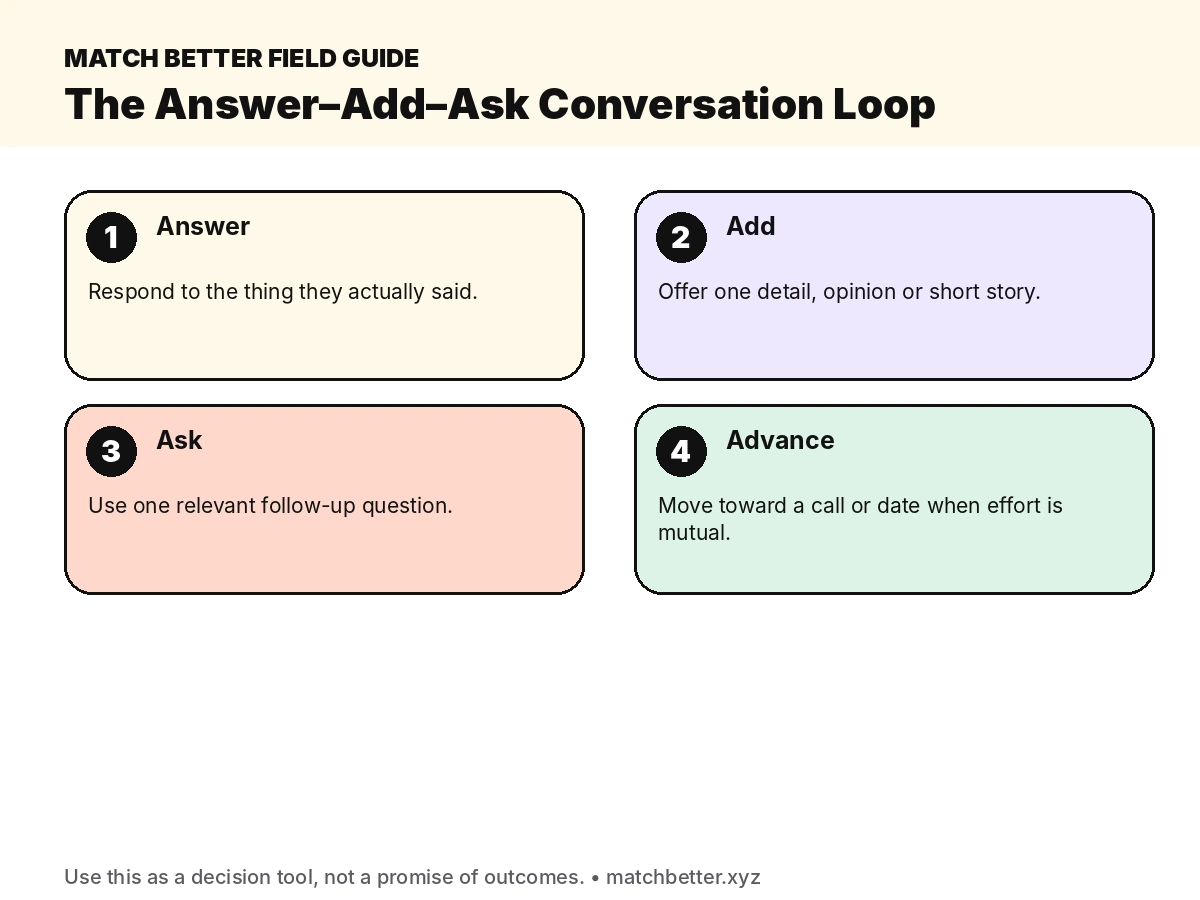
When a person asks something, do not answer with one word and throw back the same question. Use three moves:
- Answer the actual question.
- Add one detail, opinion or short story.
- Ask a related follow-up.
Them: “What are you doing this weekend?”
Flat: “Meeting friends. You?”
Better: “Trying a tiny ramen place my friend has been overselling for a month. I am prepared to judge the hype. What plan are you most looking forward to?”
The second version gives a setting, emotion and response path. It is still short. Conversation becomes easier when each message contains material the other person can pick up.
Stay on the thread for one more turn
Weak chats change subjects before any subject becomes interesting. Someone mentions learning to swim, and the reply jumps straight to work. Instead, ask one follow-up: why now, what surprised them, whether they enjoy it, or what the funniest beginner moment was.
Conversation research suggests follow-up questions can increase liking because they signal responsiveness. The key is responsiveness, not quantity. A follow-up should connect to what the person just said, not interrogate a sensitive detail.
Use the “one more turn” rule: before introducing a new topic, see whether the current answer contains a noun, feeling or opinion worth exploring once more.
Build a topic ladder
Move gradually from safe facts to personality and then practical fit.
| Level | Example topic | Goal |
|---|---|---|
| Observation | A profile photo or prompt | Establish context |
| Preference | Food, music, travel, routines | Find taste and energy |
| Story | A memorable attempt, mistake or win | Reveal personality |
| Value | What a good week or relationship feels like | Understand fit |
| Plan | A call, coffee, walk or activity | Test real-world interest |
Do not jump from “nice dog” to “what are your attachment issues?” Depth works when earned. The ladder also does not need to be climbed in one sitting. Let the conversation breathe.
Balance questions with self-reveal
Questions alone can sound interested but leave the other person doing all the work. After one or two questions, contribute an opinion or story without waiting to be asked.
Interview: “Where did you travel? How long? Who went with you?”
Conversation: “Kerala during monsoon sounds cinematic and mildly inconvenient. I did Goa once in peak rain and learned that every plan becomes a café plan. What was the best unexpected part?”
The self-reveal does two jobs. It makes you knowable, and it gives the recipient multiple hooks. Keep it proportional; a short anecdote is useful, an autobiography is not.
Use message length and pacing as feedback
Match effort more than clock time. A thoughtful paragraph can deserve a thoughtful paragraph. A one-line answer does not require a six-line rescue operation. There is no universal rule that waiting exactly two hours creates attraction.
Reply when you can be present. Avoid five consecutive messages when one composed message would work. If you are busy, a simple “Long workday—I want to answer this properly later” is clearer than disappearing mid-thread when the conversation has become meaningful.
On Bumble, read receipts are not a standard feature, so do not invent stories about whether someone saw a message. Across apps, response speed can reflect work, notification settings, travel, interest or dozens of other factors.
Know when to change medium
Text is useful for establishing comfort and fit, but it is a poor long-term substitute for meeting. Once both people have contributed, you have at least one shared thread and practical interest seems plausible, propose a small next step.
That can be a short in-app voice/video call where available, or a specific public date. Keep the proposal low-pressure: “I am enjoying this. Want to continue it over coffee near Bandra this weekend—Saturday afternoon or Sunday?”
Do not force a phone number immediately. Let the other person choose the channel and keep personal information private until comfortable.
Stop carrying a one-sided chat
One quiet message is not a verdict. A repeated pattern is information. If you are always asking, adding and reviving while the other person gives minimal answers and no curiosity, use one clean reset.
“Feels like this week may be hectic. I have enjoyed talking—message me when you have the bandwidth to continue.”
Then stop. Do not send a guilt message, a joke about being ignored or a demand for explanation. Interest can fluctuate, and nobody owes extended conversation after a match. Your task is to make participation easy, not to perform both roles forever.
Five dead-end replies rewritten
| Dead end | Better response |
|---|---|
| “Nice” | “That sounds genuinely fun. I tried it once and discovered I have zero coordination—what made you stick with it?” |
| “I work in tech” | “I work in product, mostly translating three teams that use the same words differently. What part of your work do you actually enjoy?” |
| “Went out with friends” | “We tried a new bar and spent most of the night ranking terrible song choices. What does a good friends night look like for you?” |
| “Haha” | “I am choosing to treat that as approval. Your turn: what harmless opinion gets you into trouble?” |
| “Busy week” | “Same—mine has been meeting-shaped. No pressure to live in the app; what are you looking forward to once it calms down?” |
Notice that each reply contains something personal and only one question.
Action checklist
- Answer the actual message before changing subjects.
- Add a concrete detail or opinion.
- Ask one related question.
- Use at least one follow-up before jumping topics.
- Balance curiosity with self-reveal.
- Match effort rather than playing timing games.
- Avoid message stacks and essays.
- Move from facts toward stories and values gradually.
- Propose a small next step when interest is mutual.
- Stop carrying a repeatedly one-sided conversation.
Frequently asked questions
How do I stop a dating app chat from becoming an interview?
Answer their question, add your own detail and ask one relevant follow-up. Questions should alternate with self-reveal rather than arrive as a list.
What should I talk about after the opener?
Stay with the first topic for another turn, then move through preferences, stories, values and a practical plan when the exchange feels mutual.
How quickly should I reply on Bumble or Hinge?
Reply when you can engage thoughtfully. There is no reliable universal delay that creates attraction; repeated effort and clarity matter more than a stopwatch.
When should I ask for a date?
Once both people have contributed, a shared thread exists and practical interest is plausible. A specific, low-pressure proposal is better than endless chat.
What if I am the only one asking questions?
Try one reset or open invitation, then step back. A sustainable conversation requires reciprocal effort.
Sources and update notes
This guide was checked against official product documentation and primary research available on 9 September 2026. Dating-app features can change by market, account and app version.
- Journal of Personality and Social Psychology: Question-asking increases liking (PubMed)
- Bumble Support: Your conversations
- Hinge: Convo Starters and comments
- Hinge: Guide to using AI in dating
Read next
Find your actual bottleneck
More swipes will not rewrite a weak profile. Take Match Better's free, private diagnosis and get a clear first fix: Start the free diagnosis.
Match Better is an independent education and coaching product for adults 18+. Bumble and Hinge are trademarks of their respective owners. No outcome is guaranteed. Never share a dating-app password with a coach or tool.