When and How to Ask Someone Out on Bumble or Hinge
Ask too early and the person may not have enough context to feel comfortable. Wait forever and the chat becomes unpaid correspondence. The solution is not a universal “three-day rule.” It is reading readiness, making a small plan and giving the other person an easy way to choose or decline.
Key takeaways
- Read reciprocal effort, not an arbitrary message count.
- A specific invitation is easier to answer than “we should hang out.”
- Offer two options without turning the date into a scheduling project.
- A no, silence or repeated vagueness is not a negotiation opening.
- Public venues, independent transport and privacy are basic first-date safeguards.
In this guide
- The four readiness signals
- Use Activity + Area + Options
- Six scripts for different situations
- What to do with “maybe,” “sometime” or no counteroffer
- Keep the first plan small
- Confirm without over-texting
- Invitation rewrites
- Action checklist
- Frequently asked questions
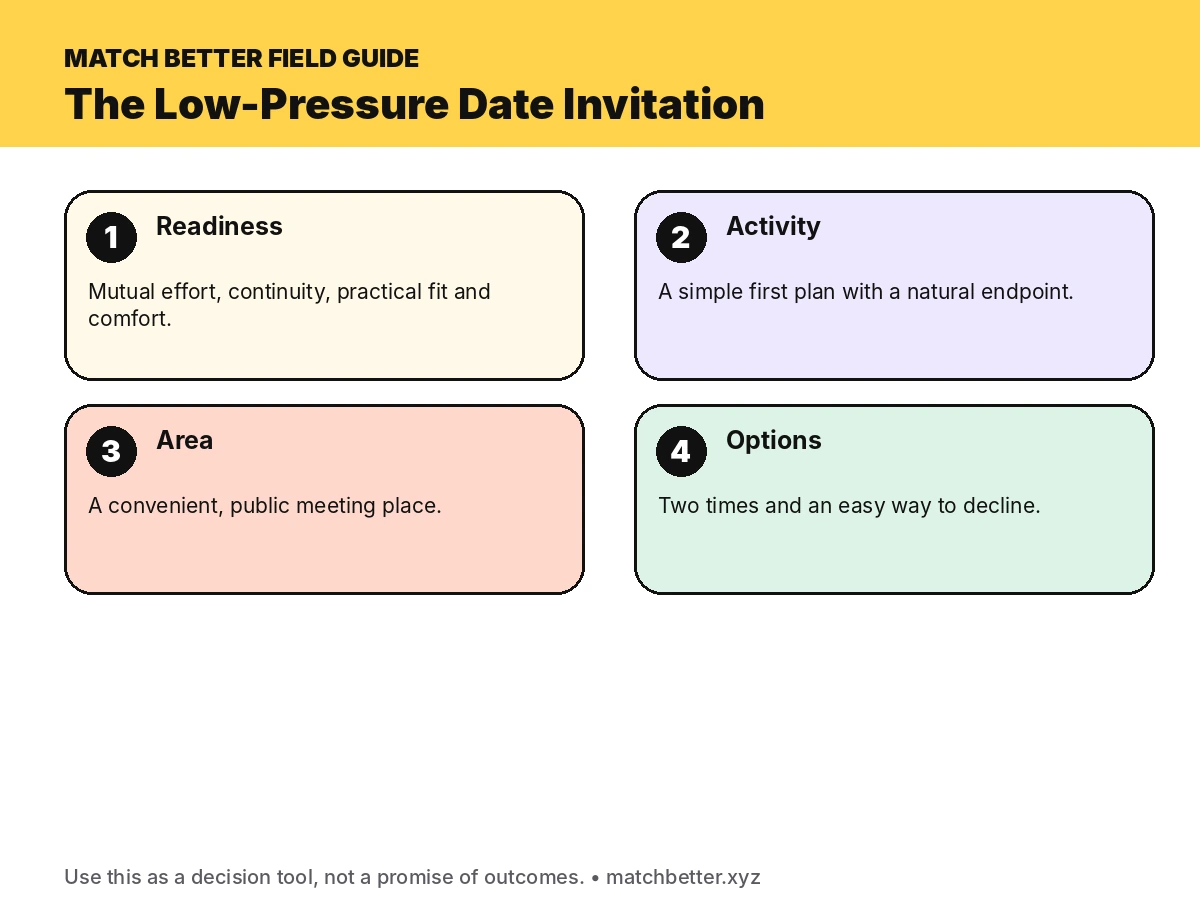
The four readiness signals
Look for a pattern rather than one emoji.
- Reciprocity: both people ask, reveal and respond.
- Continuity: the chat has at least one topic with real back-and-forth.
- Practical fit: broad location, intention and availability are not obviously incompatible.
- Comfort: the tone feels respectful, with no boundary pushing or pressure.
A conversation can reach these signals in one engaged evening or over several days. A high message count without reciprocity is not readiness. Likewise, a short but thoughtful exchange can be enough for a low-stakes proposal.
Use Activity + Area + Options
A useful invitation contains three elements:
- Activity: coffee, a walk in a busy public space, a casual meal or another simple shared interest.
- Area: a convenient public neighbourhood or landmark, not a private address.
- Options: two realistic windows.
Example: “I am enjoying this. Want to continue over coffee in Indiranagar—Saturday afternoon or Sunday early evening?”
This is clearer than “meet sometime?” and lighter than planning a five-hour itinerary. The phrase “I am enjoying this” connects the invitation to the existing conversation rather than making it feel transactional.
Six scripts for different situations
After a good shared-interest thread: “We have discussed this bakery enough to require evidence. Coffee and a taste test in Bandra this weekend?”
After a fast, engaged chat: “This is easier than most app conversations. Want to continue it in person—Thursday after work or Saturday afternoon?”
When schedules are busy: “No need to keep coordinating live. I am free Sunday 4–6 near CP; does a quick coffee fit?”
When they prefer more comfort first: “Completely fair. We can keep chatting or do a ten-minute in-app call first—whichever feels easier.”
After rescheduling once: “Tuesday does not work for me, but Thursday 7 or Sunday 5 does. If neither fits, send a time that does.”
When interest seems low: “I have enjoyed talking. I would be up for coffee next week; if the timing is not right, no pressure.”
Every script makes space for a real answer.
What to do with “maybe,” “sometime” or no counteroffer
A vague answer can mean uncertainty, a busy week, low interest or discomfort. Do not demand a reason. Clarify once.
“Sounds like this week is uncertain. Message me when you know a day that works.”
Then hand over the next move. If someone declines but offers another time, that is useful interest. If they repeatedly decline without a counteroffer, treat the pattern as a no and move on respectfully.
Do not send “I knew you were not serious,” “why match then?” or repeated alternatives. Consent to a date should be willing, not worn down.
Keep the first plan small
A first app date should make evaluation easy, not create sunk cost. Aim for a setting where either person can leave comfortably after 45–90 minutes. Avoid expensive surprises, isolated drives, private homes and plans that require one person to depend on the other for transport.
Choose a place with clear public access and ordinary staff presence. Confirm the day and rough duration. Each person should arrange their own journey. Share the plan with a trusted friend and avoid sending home or office addresses before trust exists.
Small does not mean low effort. Being on time, choosing a workable place and communicating clearly are effort.
Confirm without over-texting
Once a plan is set, continue normal conversation if it flows. You do not need to maintain an all-day chat to prove interest. Send a simple confirmation the day before or earlier that day:
“Still good for 6:30 at ___? I will be there a few minutes early.”
If there is no confirmation and the journey is significant, do not travel on an assumption. Ask once. Hinge also offers date-related features in some versions; use them only for real plans and follow the interface shown in your app.
After the date, be direct. “I had a good time and would like to see you again” is stronger than strategic silence.
Invitation rewrites
| Weak invitation | Better invitation |
|---|---|
| “We should chill” | “Want to grab coffee near Powai on Sunday afternoon?” |
| “When are you free?” | “I can do Thursday after work or Saturday around 4—does either suit you?” |
| “Come over” | “Let us meet at the café by the metro first; public and easy for both of us.” |
| “I have a surprise planned” | “I found a small bookstore café you may like. Comfortable with that, or prefer a normal coffee?” |
| “You keep avoiding me” | “Looks like timing is difficult. Message me when you have a day that genuinely works.” |
Clarity is attractive because it removes work while preserving choice.
Action checklist
- Look for mutual effort and a real conversation thread.
- Check broad location and intention fit.
- Suggest one simple activity.
- Name a convenient public area.
- Offer two realistic time options.
- Give an easy, pressure-free way to decline.
- Clarify vagueness once, then step back.
- Use independent transport and protect private addresses.
- Confirm before travelling.
- Be direct and respectful after the date.
Frequently asked questions
How many messages before asking someone out?
There is no reliable fixed number. Ask when both people have contributed, one thread has developed and the practical and comfort signals are positive.
Is it too soon to ask for coffee on the first day?
Not automatically. A respectful, public, low-pressure invitation can work after a genuinely engaged exchange. Accept if the person prefers more conversation first.
What is the best way to ask for a date?
Name a simple activity, convenient public area and two time options. Keep the tone direct and easy to decline.
What if they say they are busy?
Offer one alternative or ask them to suggest a time. If there is repeated vagueness without a counteroffer, step back.
Should I ask for their number before the date?
It is optional. Keep the conversation in-app until both people are comfortable sharing contact details.
Sources and update notes
This guide was checked against official product documentation and primary research available on 9 September 2026. Dating-app features can change by market, account and app version.
- Bumble Support: Your conversations
- Bumble Support: Safety features
- Hinge Help: Signals
- Hinge: Guide to using AI in dating
Read next
Find your actual bottleneck
More swipes will not rewrite a weak profile. Take Match Better's free, private diagnosis and get a clear first fix: Start the free diagnosis.
Match Better is an independent education and coaching product for adults 18+. Bumble and Hinge are trademarks of their respective owners. No outcome is guaranteed. Never share a dating-app password with a coach or tool.