How the Hinge Algorithm Works in 2026: Confirmed Signals, Myths and a Better Test
Search for the Hinge algorithm and you will meet an imaginary machine with an exact score, a punishment for every pause and a ritual for resetting your account. The real product is less cinematic and more useful. Hinge runs several recommendation and discovery systems, publishes broad inputs for some of them and keeps the detailed ranking logic private. That means we can optimise what is confirmed and test what is measurable, without dressing guesses as facts.
Key takeaways
- There is no public complete Hinge ranking formula or inspectable score.
- Discover is framed around mutual fit with preferences.
- Most Compatible, Standouts and Signals have different purposes and inputs.
- Paid priority and Boosts affect distribution but do not manufacture interest.
- Profile quality, honest selection and real conversation remain the controllable levers.
In this guide
- There is not one “Hinge algorithm”
- What Hinge officially confirms
- The four inputs you can reasonably optimise
- Algorithm myths to stop treating as facts
- Use a 14-day controlled test
- What a healthy Hinge routine looks like
- A diagnosis matrix for Hinge results
- Action checklist
- Frequently asked questions
There is not one “Hinge algorithm”
Hinge has multiple product surfaces. Discover recommends profiles; Likes You handles incoming interest; Standouts highlights high-attention profiles; Most Compatible singles out a predicted fit; Signals reflects recent participation; Boost and subscription features affect visibility or access.
Each surface answers a different question. “Who might fit both sets of preferences?” is different from “Which profiles are receiving attention?” and different again from “Who has recently participated thoughtfully?” Treating all of them as one secret score creates bad advice.
Hinge publishes enough to identify broad categories, but not the exact weights, thresholds or order of every profile. Any person claiming a precise equation is filling gaps with speculation.
What Hinge officially confirms
The current help and newsroom material supports the following statements:
- Discover: recommendations are based on mutual fit—each person fits the other’s stated preferences.
- Likes and comments: a Like can target a specific photo or prompt, and a comment creates context before the match.
- Most Compatible: recommendations consider mutual preferences, recent activity and shared Like patterns.
- Standouts: the feed contains profiles receiving significant attention, tailored to preferences and recent activity.
- Signals: the badge draws on recent patterns such as reviewing profiles, commenting, processing Likes, messaging and confirming dates, after baseline eligibility.
- Paid products: HingeX, Boosts and Roses can alter access, timing or priority.
None of these sources says a subscription guarantees matches or that one behaviour controls the entire feed.
The four inputs you can reasonably optimise
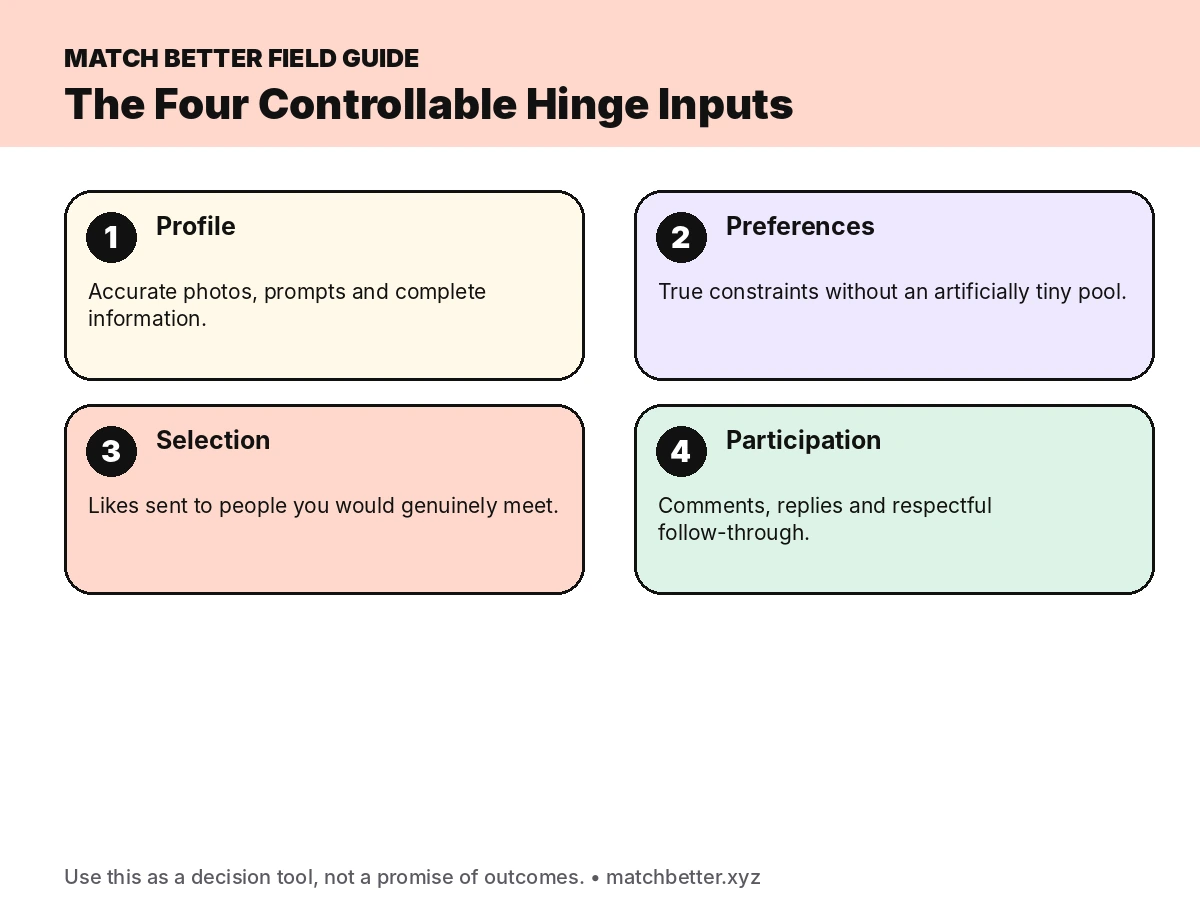
1. Profile information. Complete fields accurately. Photos and prompts give both people and recommendation systems more context.
2. Preferences. Use hard dealbreakers only for genuine constraints. Extremely narrow settings can create a tiny pool; inaccurate broad settings create irrelevant recommendations.
3. Selection behaviour. Like people you would actually meet. Thoughtful selection produces cleaner behavioural information than indiscriminate swiping.
4. Participation quality. Comments, replies and closed loops improve the human funnel and align with the behaviours Hinge now describes through Signals.
These levers are unglamorous because they require judgment. That is exactly why they are more durable than a timing hack copied from a forum.
Algorithm myths to stop treating as facts
| Claim | What we can responsibly say |
|---|---|
| “Hinge has a public Elo score” | Hinge does not publish an inspectable score or full formula |
| “Always Like the hottest profiles to improve your ranking” | This confuses attention with compatibility and may produce noisy behaviour |
| “Delete and recreate until you get a fresh-account boost” | No current official source promises a durable advantage; repeated resets can lose data and matches |
| “A paid plan makes people like you” | Paid features affect access or distribution, not another person’s preference |
| “One quiet day means shadowban” | Daily pool, activity and randomness vary; diagnose over a longer window |
| “Send every Like at one exact hour” | Timing can affect who is active, but Hinge does not publish a universal magic hour |
A myth may occasionally coincide with a better week. That does not establish causation.
Use a 14-day controlled test
Start with one profile version. Keep the city, intention, age range and daily effort stable. Record:
- outgoing Likes and how many include comments;
- matches from those Likes;
- incoming Likes;
- conversations reaching at least four meaningful exchanges;
- plans proposed and accepted;
- fit quality, not merely volume.
For the next 14-day cycle, change one major variable: lead photo, prompt set, preference range or paid reach. Do not change all four and then announce that “the algorithm improved.”
Small samples are noisy, so interpret direction rather than pretending statistical certainty. The objective is to find the weakest controllable stage.
What a healthy Hinge routine looks like
A healthy routine is selective, current and sustainable. Review a modest number of profiles, send specific comments when there is a hook, process incoming Likes, reply when interest is real and stop conversations respectfully when it is not. Refresh stale photos or prompts because your life changed—not because a creator declared Tuesday a reset day.
Use paid tools only after the free funnel is understood. A Boost can test visibility; Hinge+ can test access; HingeX can test recommendation speed and priority. Each result should answer one question.
The best “algorithm optimisation” is making it easier for the right person to recognise an accurate version of you and start a conversation.
A diagnosis matrix for Hinge results
| Pattern | Likely bottleneck | Next test |
|---|---|---|
| Few incoming Likes and few outgoing matches | Profile conversion or reach | Test lead photo before paying, then one Boost if needed |
| Matches occur but comments get weak replies | Positioning or conversation | Rewrite prompts and opener structure |
| Incoming Likes are mostly poor fit | Preferences or profile signal | Tighten true dealbreakers and clarify intention |
| Good conversations but no plans | Ask-out timing and specificity | Use a clear, low-pressure proposal |
| Paid reach increases views/interest but not fit | Positioning is broad | Refine whom the profile is designed to attract |
This matrix does not reveal a secret ranking score. It converts outcomes into the next responsible experiment.
Action checklist
- Treat Discover, Standouts, Most Compatible and Signals as different systems.
- Complete and verify an accurate profile.
- Use only genuine dealbreakers as hard preferences.
- Send selective Likes to people you would meet.
- Use comments when a real profile hook exists.
- Reply and close loops consistently.
- Ignore precise score claims without primary evidence.
- Run one-variable 14-day tests.
- Use paid tools only to test a named bottleneck.
- Measure fit and conversation—not only match count.
Frequently asked questions
Does Hinge use an Elo score?
Hinge does not publish a current inspectable Elo score or complete ranking formula. It does describe broad inputs and the purposes of specific recommendation surfaces.
How can I get shown more on Hinge?
First improve profile conversion and maintain accurate preferences and thoughtful participation. A Boost or HingeX feature may affect distribution, but neither guarantees interest.
Should I delete and remake my Hinge account?
Do not use deletion as a routine optimisation trick. Rebuild only for a legitimate account reason and after considering lost matches, history and current platform rules.
Does commenting help the Hinge algorithm?
Hinge identifies comments as part of thoughtful participation for Signals, and comments give recipients more context. It does not publish a universal ranking boost for every comment.
What is the best time to use Hinge?
Use it when you can read profiles and reply thoughtfully. Activity patterns vary by audience and city; Hinge does not publish one universal magic hour.
Sources and update notes
This guide was checked against official product documentation and primary research available on 9 September 2026. Dating-app features can change by market, account and app version.
- Hinge Help: Discover Feed
- Hinge Help: Likes and comments
- Hinge Help: Most Compatible
- Hinge Help: Standouts
- Hinge Help: Signals
- Hinge Help: Subscription and purchase benefits
- Hinge Help: Boost and Superboost
Read next
Find your actual bottleneck
More swipes will not rewrite a weak profile. Take Match Better's free, private diagnosis and get a clear first fix: Start the free diagnosis.
Match Better is an independent education and coaching product for adults 18+. Bumble and Hinge are trademarks of their respective owners. No outcome is guaranteed. Never share a dating-app password with a coach or tool.