Hinge Most Compatible Explained: What It Means and What to Do Next
A Most Compatible card can feel unusually important because Hinge singles out one profile and gives it a confident label. That creates two bad reactions: sending a generic Like because “the app chose them,” or overthinking the card as if an algorithm has discovered your future. The useful middle ground is to treat the recommendation as a high-priority profile review, then make the same human decision you would make anywhere else.
Key takeaways
- Most Compatible is a prediction, not a mutual Like notification.
- The recommendation considers fit signals and recent activity, according to Hinge.
- A recommendation usually remains available for a limited period, so review it deliberately.
- Read practical details before getting excited by the label.
- Send a specific comment only when the profile genuinely fits.
In this guide
- What does Most Compatible mean on Hinge?
- Does Most Compatible mean they already liked you?
- What information might influence the recommendation?
- Use the four-question review before sending a Like
- How to write the comment
- What if Most Compatible keeps missing the mark?
- Three Most Compatible scenarios
- Action checklist
- Frequently asked questions
What does Most Compatible mean on Hinge?
Hinge describes Most Compatible as a recommendation designed to surface someone the app believes you are especially likely to connect with. When the feature is available to you, it appears near the top of Discover and is typically refreshed on a regular cycle.
The recommendation is not random, but Hinge does not publish a complete formula. Its help material points to mutual preferences, recent activity and shared patterns—such as the types of people you and people with similar tastes tend to like. In plain English, Hinge is looking for a plausible two-way fit inside the information and behaviour it can observe.
That is useful context, not a verdict. The system cannot know chemistry, emotional availability, whether either person will notice the Like, or whether two schedules can produce an actual date.
Does Most Compatible mean they already liked you?
No. A Most Compatible recommendation is not the same as an incoming Like. Unless the profile is separately visible in Likes You, do not assume the person has seen you or expressed interest.
This distinction changes how you should message. Avoid lines such as “Hinge says we are meant to be” or “apparently you are my best match.” They add pressure and make a product label the centre of the interaction. Comment on something the person deliberately put in the profile instead.
A recommendation may increase the relevance of a profile in your feed, but the normal matching rules still apply: you send a Like or comment, the other person decides whether to match, and either person can choose not to continue.
What information might influence the recommendation?
Hinge confirms several broad inputs but keeps the full ranking system private. The useful, non-speculative list is:
- Mutual preferences: whether each profile falls inside the other person’s stated parameters.
- Recent activity: whether the recommendation is timely rather than built from an abandoned account.
- Like patterns: the kinds of profiles you engage with and patterns among people with similar preferences.
- Profile information: the attributes and content each person has chosen to provide.
Do not turn these categories into internet mythology. There is no official public “compatibility score” you can inspect, no published percentage attached to the card and no evidence that liking every Most Compatible recommendation will train the app in your favour. The feature is designed to help discovery; it is not an instruction to override your standards.
Use the four-question review before sending a Like
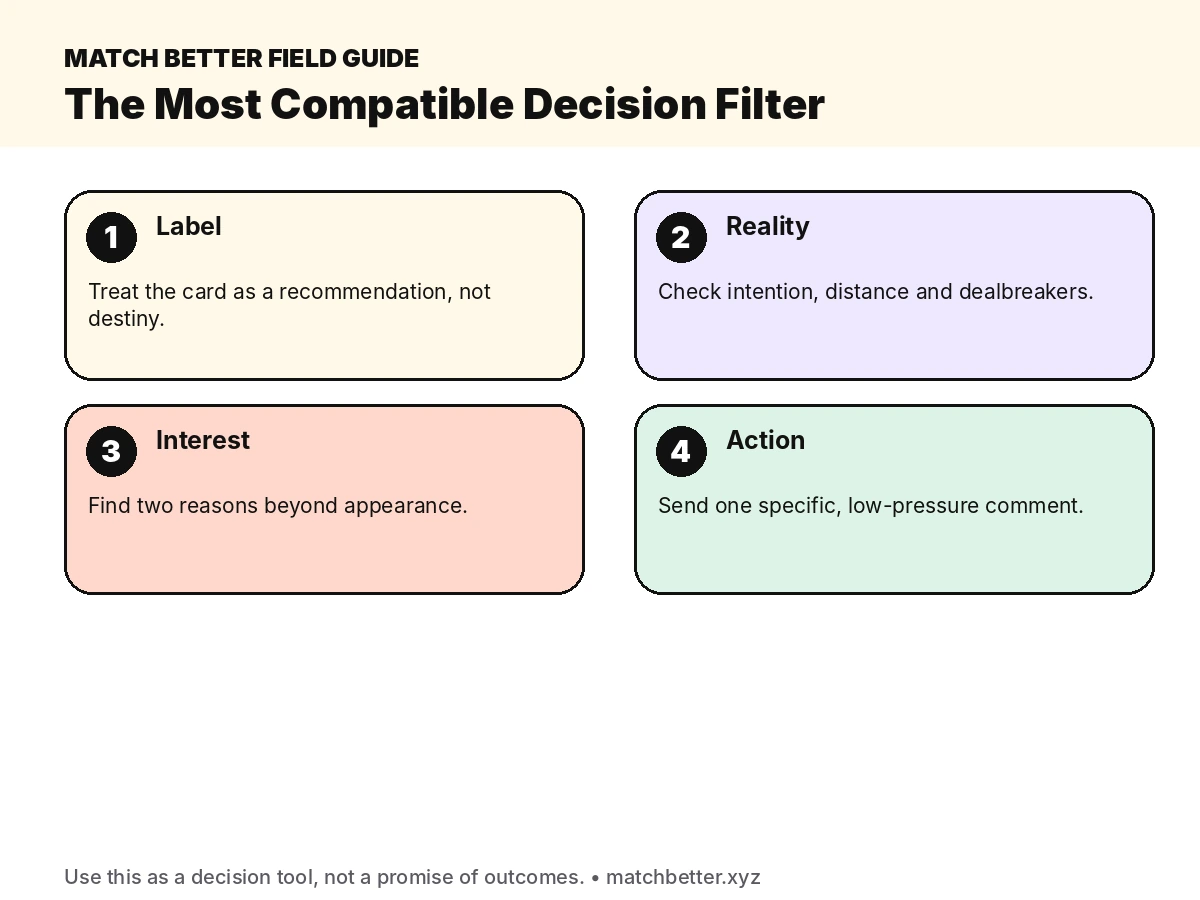
Before acting on the recommendation, answer four questions.
- Is the practical fit real? Check location, dating intention and genuine dealbreakers.
- Can I name two non-appearance reasons I am interested? This protects you from reacting only to a polished first photo.
- Is there a natural comment hook? A specific observation should be possible without performing comedy.
- Would I be pleased to match even without the label? Remove the interface badge mentally and judge the profile itself.
When all four are yes, send the Like while the recommendation is visible. When the profile fails a real requirement, pass. An algorithmic nudge should not turn a preference into a compromise.
How to write the comment
Use the same rule that works elsewhere on Hinge: notice one specific detail, reveal a small piece of yourself and leave an easy response path.
Weak: “Hinge thinks we are compatible 👀”
Better: “Your Sunday breakfast ranking is brave. I agree on dosa at number one, but putting pancakes above poha needs a defence.”
Weak: “You seem perfect.”
Better: “That pottery photo looks much calmer than my first attempt. Did you make anything that survived the wheel?”
The better versions prove that you read the profile. They also give the other person something concrete to answer. A recommendation can get your attention; the comment still has to earn curiosity.
What if Most Compatible keeps missing the mark?
A strange recommendation does not mean your account is broken. Your preferences may be broad, your recent Likes may be inconsistent, or the available pool may be limited. The system also has imperfect information because profiles cannot capture every criterion that matters to you.
Review three things before changing anything: whether your preferences reflect true constraints, whether your own profile clearly communicates your intended audience, and whether your Likes represent people you would genuinely meet. Then use Hinge normally for at least a couple of weeks rather than trying to “correct” one card with frantic activity.
Judge the feature over multiple recommendations. One irrelevant card is noise; a repeated pattern may reveal that your stated settings or actual choices are sending mixed signals.
Three Most Compatible scenarios
| Scenario | Best response | Why |
|---|---|---|
| Strong practical fit and a specific prompt hook | Send a comment now | The label supports a decision you already understand |
| Attractive profile but incompatible intention or distance | Pass | A recommendation does not erase a real constraint |
| Interesting profile but almost no information | Send a light question only if interest is genuine | Do not manufacture certainty from a thin profile |
Example comment: “You have both long runs and late-night biryani on the same profile. Is one the reason the other is possible?”
Example pass: The profile is polished, but their stated relationship intention conflicts with yours. Passing is not “wasting” the recommendation. It is using the feature correctly.
Action checklist
- Do not assume the person has already liked you.
- Check dating intention, location and real dealbreakers.
- Remove the Most Compatible label mentally and judge the profile.
- Identify two reasons for interest beyond appearance.
- Comment on a profile detail, not the recommendation badge.
- Avoid destiny jokes and pressure.
- Pass when practical fit is weak.
- Evaluate the feature over several recommendations, not one.
Frequently asked questions
Does Hinge Most Compatible mean they liked me?
No. It is a recommendation in Discover, not evidence of an incoming Like. You still need to send a Like or comment and wait for the other person’s choice.
How does Hinge choose Most Compatible?
Hinge says the feature uses mutual preferences, recent activity and patterns such as the people you and people with similar preferences tend to like. The complete formula is not public.
How often does Most Compatible change?
Hinge presents the recommendation on a recurring basis and the card is time-limited. Exact availability can vary by account, so review the label and timer shown in your app.
Is Most Compatible guaranteed to match?
No. It predicts potential fit; it cannot guarantee a Like, reply, date or real-world chemistry.
Should I always Like my Most Compatible?
No. Send a Like only when the person meets your practical criteria and you have genuine interest. Passing gives Hinge an honest preference signal and protects your time.
Sources and update notes
This guide was checked against official product documentation and primary research available on 9 September 2026. Dating-app features can change by market, account and app version.
Read next
Find your actual bottleneck
More swipes will not rewrite a weak profile. Take Match Better's free, private diagnosis and get a clear first fix: Start the free diagnosis.
Match Better is an independent education and coaching product for adults 18+. Bumble and Hinge are trademarks of their respective owners. No outcome is guaranteed. Never share a dating-app password with a coach or tool.