Hinge Signals Explained: What the Badge Means and How to Earn It
Signals looks like a reputation score, which makes it easy to misunderstand. It is not a blue tick for being a “better person,” and the absence of a badge does not make someone unsafe or unserious. It is Hinge’s attempt to surface recent participation patterns that the app can observe. The right way to respond is not to perform for the badge; it is to use the behaviours as a quality checklist for how you already date.
Key takeaways
- Signals reflects recent in-app behaviour, not identity or worth.
- The badge has baseline eligibility requirements and behavioural criteria.
- Hinge says it cannot be bought and updates as activity changes.
- Thoughtful comments and actual replies matter more than raw app time.
- Use the badge as one small trust cue, never as proof of compatibility or safety.
In this guide
- What is the Hinge Signals badge?
- What are the baseline requirements?
- Which behaviours count toward Signals?
- How to build the behaviours without gaming the system
- Does Signals improve your reach or match rate?
- How should you interpret another person’s badge?
- A seven-day thoughtful-use routine
- Action checklist
- Frequently asked questions
What is the Hinge Signals badge?
Hinge describes Signals as a feature that recognises people who participate thoughtfully over time. The badge can appear on a profile when the account meets baseline requirements and enough recent behavioural criteria.
The word “dynamic” is important. This is not a permanent award. Hinge says the feature looks at a rolling period of recent activity and updates regularly. Someone may gain or lose the badge as their use changes, and a newer or less-active member may not have enough activity for it to appear.
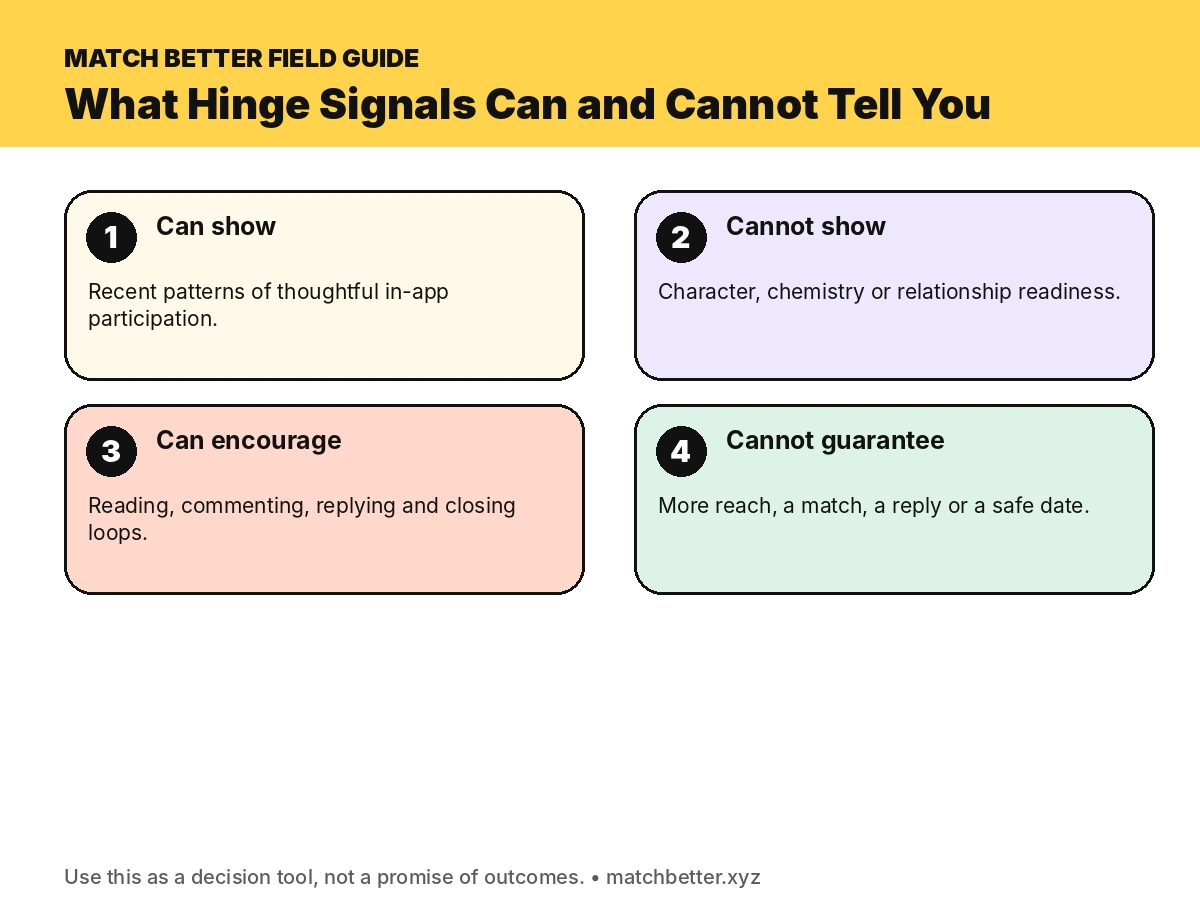
Treat Signals as context about participation inside Hinge. It does not certify personality, relationship readiness, honesty outside the app or how someone will treat you on a date.
What are the baseline requirements?
According to Hinge’s current help material, a member first needs a complete profile, selfie verification and an account in good standing to be considered for Signals. These requirements are sensible trust basics, but none is a guarantee.
A complete profile gives the system and potential matches more information. Selfie verification checks that the person completing the process matches the profile photos. Good standing means the account is not restricted for violating platform rules.
Complete these steps because they reduce avoidable uncertainty, not because you are chasing a badge. Your profile should already be accurate, current and respectful before any feature evaluates your activity.
Which behaviours count toward Signals?
Hinge lists five broad behaviours and says a person needs to show a majority of them consistently. The behaviours are:
- Looking before liking: reviewing profiles rather than sending reflexive Likes.
- Adding comments: making Likes more intentional and easier to answer.
- Reviewing incoming Likes: engaging with people who have already expressed interest.
- Messaging matches: not collecting matches without conversation.
- Confirming dates: using Hinge’s date-confirmation flow when a plan happens.
The precise thresholds are not public and should not become a target. The practical lesson is enough: read, choose, communicate and close loops. These are useful habits even when no badge appears.
How to build the behaviours without gaming the system
Use a small daily routine rather than bursts of frantic activity.
- Review a manageable number of profiles and pass honestly.
- Attach a comment when a profile provides a real hook.
- Check incoming Likes before spending all your attention in Discover.
- Reply to matches you genuinely want to know, and unmatch respectfully when you do not.
- When a date is arranged through the app, use the confirmation feature as intended.
Do not send empty comments to inflate a metric, message matches you dislike or confirm plans that do not exist. Those actions defeat the purpose and create worse experiences. A badge obtained through low-quality behaviour would not improve the underlying profile or conversation.
Does Signals improve your reach or match rate?
Hinge presents Signals as a badge that helps members understand thoughtful participation. Its public explanation does not promise a reach boost, priority ranking or higher match rate for earning it. Do not treat correlation as causation if results improve at the same time.
The underlying behaviours can help indirectly. Reading profiles produces better selection, comments create stronger context, and replying gives matches a chance to become conversations. That is ordinary funnel improvement, not proof of an algorithmic reward.
Track meaningful outcomes—mutual matches, substantive replies and dates with good fit—rather than whether the badge appears. The badge is feedback; it is not the goal.
How should you interpret another person’s badge?
A Signals badge can be a mild positive cue that the person has recently used Hinge in the ways the platform defines as thoughtful. It should sit beside, not replace, the profile itself.
Still inspect consistency, intention, communication and safety. A badge cannot tell you whether someone shares your values, whether a story is true or whether they will respect a boundary. Conversely, an account without Signals may be new, inactive, private about date confirmation or simply outside the eligibility pattern.
Use the badge as one sentence in a long profile, not the entire biography.
A seven-day thoughtful-use routine
Day 1: Complete every profile field, remove outdated photos and finish selfie verification.
Days 2–7: Review a small number of profiles slowly. Send fewer, more specific comments. Process incoming Likes. Reply to matches you genuinely want to continue. Close conversations respectfully when the fit is not there.
When a plan is made: Use Hinge’s date-confirmation flow only for a real plan.
What not to do: Do not spam comments, collect matches, fabricate dates or keep conversations alive solely to influence a badge. The routine is successful when app use becomes more intentional—even if Signals does not appear immediately.
Action checklist
- Complete every required profile element accurately.
- Finish selfie verification where available.
- Keep the account in good standing.
- Read profiles before sending Likes.
- Add specific comments when a hook exists.
- Review incoming Likes instead of ignoring them.
- Message matches you genuinely want to know.
- Confirm real dates, never invented ones.
- Do not buy or fake activity for a badge.
- Treat another person’s badge as a minor cue, not proof.
Frequently asked questions
What does Signals mean on Hinge?
It is a dynamic badge intended to reflect recent thoughtful participation, based on eligibility requirements and patterns such as reading, commenting, reviewing Likes, messaging and confirming dates.
How do I get the Hinge Signals badge?
Complete and verify your profile, remain in good standing and consistently use a majority of the thoughtful-participation behaviours described by Hinge. Exact thresholds are not public.
Can I pay for Hinge Signals?
No. Hinge says the badge cannot be purchased. A subscription may change product access, but it does not buy Signals.
How long does Hinge Signals use my activity?
Hinge says the badge is based on a recent rolling activity window and refreshes regularly. Consult the current in-app explanation because product details can change.
Does no Signals badge mean someone is a bad match?
No. The badge is not a compatibility, safety or character score. A person may be new, less active or simply not meet the current activity criteria.
Sources and update notes
This guide was checked against official product documentation and primary research available on 9 September 2026. Dating-app features can change by market, account and app version.
Read next
Find your actual bottleneck
More swipes will not rewrite a weak profile. Take Match Better's free, private diagnosis and get a clear first fix: Start the free diagnosis.
Match Better is an independent education and coaching product for adults 18+. Bumble and Hinge are trademarks of their respective owners. No outcome is guaranteed. Never share a dating-app password with a coach or tool.